Text Info Strip

Kyle Simmonds Crowned Overall Division 1 SACA MVP

The 2025/26 domestic cricket season concludes with Western Province all-rounder Kyle Simmonds named Division 1 Overall SACA MVP. Simmonds earned…

Read More

Liam Alder Named Overall SACA MVP for Domestic Division 2

Following the completion of all domestic fixtures, Liam Alder of the Garden Route Badgers finished at the top of the…

Read More

TWELVE YEARS OF RESEARCH-BASED PLAYER SERVICE

Over the past 12 years, the South African Cricketers’ Association (SACA) has cemented its dedication to evidence-based practice through a…

Read More

A DAY IN THE LIFE OF AYA MYOLI

A picture is worth a thousand words they say … We asked Dolphins bowler Ayavuya Myoli to send us a few snaps that describe him best. And here they are:

Knight rider

  1. Knight Rider: Me with my car at a garage in Bisho, where I’m from. I got the car last year.

Driving

  1. Going places: With the help of SACA, I did my learners in Kimberley three years ago. They paid for my learners and the driving school. The union helped me with the actual tests and I passed first time!

Boot camp

  1. Boot Camp: When I go home to Bisho, I help some friends out with a Boot Camp that they set up. The whole thing is basically a Herbalife sales pitch but it doesn’t hurt to do the exercises: lunges, squats, and ladies pushups. That sort of thing. Anyway, I help out where I can.

Schmodel

  1. Moving up: I started at studying Sports Science in 2010 at Fort Hare. I have three modules to go before I complete the degree. I’m planning to complete it using the Player Plus program, but I might be based in Jo’burg next year, so I may have to finish it through Unisa.
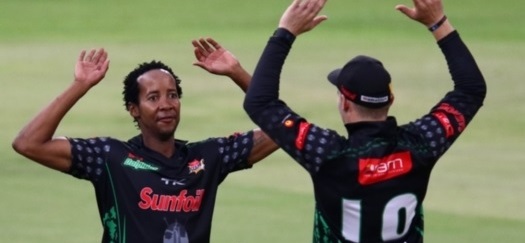
Miller high five

  1. High Five: Here’s David Miller high fiving me after wicket in the RamSlam, where we ended up in the final. Every time I got a wicket, the first person to come celebrate with me was David. He is a very chilled guy. I’ve learned a lot from him, not just on the field but off it as well.

grass roots

  1. Blue steel: Just a bit of modeling stuff I was doing on the side, haha. Some friends of mine that I grew up with in Bisho are serial entrepreneurs. They sell painting, music and clothes. The clothing thing has actually taken off quite nicely and is doing well for them. They asked me to model some of their clothes and hats. How could I say no?
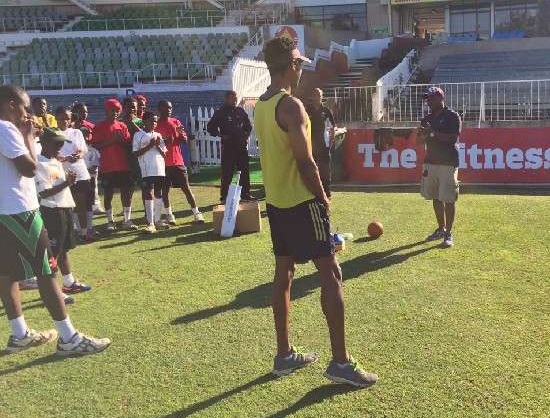
Kids

  1. Grassroots development: This was during Nelson Mandela Day. For our 68 minutes of goodwill, kids from various locations outside Durban came to Kingsmead. We did some fun stuff and a few training exercises. We enjoyed it as much as they did!

2016-04-24 15.07.17

  1. Limbering up: Fitness trainers tell us what to do in terms of conditioning, and we listen. Preparing for a game, if your warm up is good, you will play better. The warm up can affect your entire game, but more importantly prevent injuries. I take warm ups very seriously in my routine.
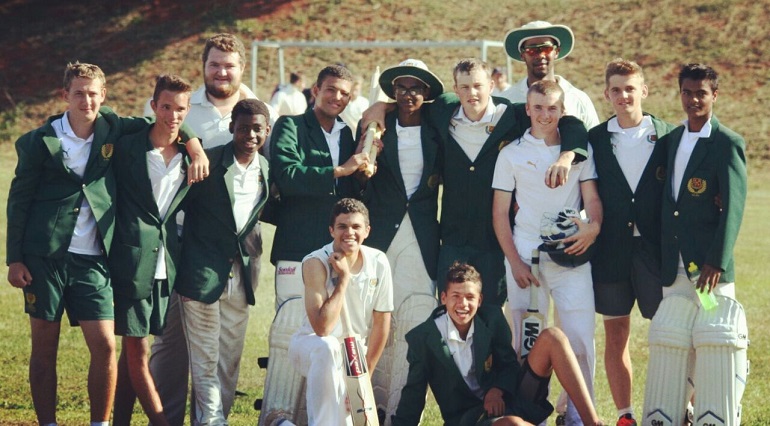
Green jackets

  1. Each one teach one: In Durban I stayed at Glenwood as a house master while also coaching the U15A team. The perks were great – like not having to cook! Also, the boy’s commitment is inspirational. They look up to you so you have to meet their expectations.

Lounge

  1. At the gym: I had a contract last season, and then I lost it. But through SACA, I was able to keep my Virgin Active membership, and that helped me a lot. Now have a contract with the Lions, so I will be able to pay my own way again, but the gym membership helped me keep in shape throughout.

Appeal

  1. Learning from the masters of spin: In 2012, I went to India with SA’s spinners bowling camp. It was three weeks long, during which I learnt a lot. It’s good to bowl in different conditions. They also taught us different methods – there is a difference in the coaching techniques and the thinking about the game.
Share:

Text Info Strip

PAIN AND GAIN

Richard das Neves and Cliffe Deacon used SACA’s Player Plus programme to maintain their medical professional status, and their cricketing backgrounds have given them an edge over some of their colleagues.

One incident sticks out in Richard das Neves’ memory when thinking about the most gruesome injury he’s ever seen on a cricket field.

“I can remember a game between Gauteng and Border at UJ,” said the former Gauteng captain, now head coach at the University.

“Temba Bavuma was batting for us and he hit one in the air. Two fielders closed in under the ball, but neither called for the catch. They collided and the knee of the big fast bowler broke the smaller fielder’s leg… badly.

“I was in the final year of my biokinetics studies and everyone looked to me to assist. I could tell straight away that his leg was broken, but you never want to tell the player that up front.”

Das Neves calmed his writhing patient, nodded to another player to call an ambulance and stabilised the injured leg with an improvised splint made out of leg pads.

Wear and tear

Shattered bones are less commonplace in Das Neves’ new profession as a biokineticist based at the Wanderers Medical Centre.

“I’m probably fortunate in that, as a bio, I don’t see many traumatic injuries anymore, I deal more with the final phase of rehab.”

“Cricket is such an overuse-sport,” pipes up Cliffe Deacon. Like Das Neves, Deacon retired in 2014 after a 12-year career with North West and the Lions. He now has a physiotherapy practise in Johannesburg.

“You seldom see acute injuries like you get in rugby, where there are high-speed collisions all the time. In cricket, it’s more of an overuse issue, but you do see things like bowlers suffering from fractured vertebrae…”

Oh so minor stuff then… wait, WHAT!?

“Javelin throwers and fast bowlers are the most prevalent with those sort of stress fractures,” said Deacon, who was once a devastating left-arm fast bowler. “It’s a big overuse injury that comes from repeating the same action all day.”

Deacon would know, his 2005 season was cut short by a spinal compression.

“There’s a big scientific part to recovering from that,” added Das Neves.  But in addition to the science, there’s also a degree of intuition. As an ex-cricketer, Das Neves has an intimate knowledge of the types of injuries that occur with cricketers, as well as the techniques that can be used to help them. “When a fast bowler is injured,” he says. “I know the biokintetics of what goes into a bowling action, and we can look at errors in his bowling technique.”

Play to work

Das Neves and Deacon became exercise and healthcare specialists through studies partly funded by SACA’s Player Plus program.

“Player Plus helped me to further my biokinetics studies by doing external courses towards continual progress development,” said Das Neves. “You have to do so many courses every year to stay in touch with developments in your field, and SACA assisted with that.

Das Neves and Deacon both agree that there is an increasing need for something like the Player Plus programme because so many players are not guaranteed to play international cricket or franchise level for an extended period. Having an academic qualification helps players to figure out how to make a living.

“I would give Player Plus a 100 percent recommendation,” said Deacon. “I’ve always been a massive supporter of people taking the onus for development on themselves, and this gives you a great platform to do that.

“Where else do you get paid to play the sport you love, and study a qualification – for free – at the same time that sets you up for the future after cricket?

“You’d be stupid not to take that opportunity.”


Share:

Text Info Strip

OMPHILE RAMELA: MENTOR AND STUDENT

Cobras Sunfoil Series captain and SA A player Omphile Ramela shares some insights on the role that the Player Plus programme is playing in his life, and his ambition to improve the general cricket landscape for all professional cricketers

Tell us a bit about your childhood.

I grew up in Soweto, raised by my mother. I started cricket through the Bakers Mini Cricket Program – I think it’s now known as KFC Mini Cricket. I then got a bursary to attend St Peters in Rivonia and then St Johns College.

How much of a personal responsibility do you feel towards mentoring the younger guys coming through?

I think there’s an enormous responsibility, that’s just the nature of cricket – as you go up, you try and pull everyone with you, and as a leader you try and fast-track everyone’s development.

But the best time to pass on any knowledge is in the heat of battle. Once you’re playing together it’s a lot easier to advise and speed up the learning process. I batted with someone like JP Duminy, and my learning experience was certainly enhanced.

You sit on the SACA Exco. What are some of the more common or recurring issues from the players’ side, and the organisation’s side?

From the players, an on-going issue in every sport is that players would like to get paid fairly, and to be rewarded for performing.

From SACA, a large part of the message has been around anti-corruption. That’s been a very strong message. Another strong message has been Player Plus, and how much the programme has grown over the years is an indication of how seriously the organisation is taking it.

What benefits has the Player Plus (PP) programme brought to your life personally?

The Player Plus programme has allowed me to continue studying my Masters (in Economics). To have that financial backup eases a lot of pressure off you. An initial amount is covered and if you pass your course, they cover all the course fees. That’s a great incentive!

I think with the passage of time, players have started to gravitate towards Player Plus. Players are starting to realise that you need to have some kind of backup to make sure that when you exit the game you have an exit strategy.

You’re doing your MA in economics. Tell us a bit about that.

I’ve always been interested in economic history. I think economics is a good way to try and understand the world.

What interests me is this whole idea of incentives and how it motivates people. Should we incentivise people to work hard, and if so, what are the benefits? It’s  fascinating if you think about it from a sports perspective.

Players should be rewarded more when they perform than when they don’t perform. That’s how you motivate people to raise their standards. In those moments when they’re doing well they have to feel the full benefit of it. So you need an incentive structure.

If a player scores a massive amount of runs then he should receive financial recognition. Then you’re acknowledging that the player has excelled. I think that’s where we can get better in SA sports in general.

By extension, you could incentivize people to develop black African cricketers. An economist would say, why not incentivize it? You could open it up to the general public and somebody really smart might know how to actually do it, and they’d be rewarded with a real monetary incentive.

And there’s a return on investment for rewarding people financially because we know in return we’re going to get more people at the gate and so on.

Are you satisfied with the pace of transformation in SA cricket?

More needs to be done. It’s only now that there’s a political need that people have woken up. If more was done over the last 15 years, we wouldn’t still be looking for numbers.

You need a lot more representation on merit, and access to facilities and coaching. We need to pay a lot more attention to the schools structures because once you get to franchise level you’re just molding the players.

Offer an incentive structure for anyone who produces players. We need to put a high price on those who produce. I don’t think our system is producing fast enough and we need to open an invitation to anyone who can do, there are some very innovative people in South Africa.


Share:

Text Info Strip

EDUCATION EASES THE PRESSURE

A new dawn beckons for Robin Peterson, who gives unique insight into how having an education to fall back on actually makes you a better cricketer.

A white Audi is parked in the driveway of Robin Peterson’s immaculate home in a quiet street in Cape Town’s southern suburbs. The house has been renovated, sliding doors open from a modern lounge onto a built-in braai and pool.

Robbie P has come a long way from the dusty streets of Gelvandale in Port Elizabeth. But in some respects he remains firmly rooted to the values of his past.

“Things have changed in the neighbourhood I grew up in. Kids have got a lot more distractions. In my day, it was quite simple. You played cricket in summer. And we were exposed to quite a lot of sports. Hockey. Football. When Wimbledon was on TV kids would be playing tennis in the streets. It was a great childhood.”

Robin remembers playing street cricket against Alviro Petersen, Ashwell Prince, Garnett Kruger, Shafiek Abrahams and even Russell Domingo – all guys who grew up in his neighbourhood. He was even coached for a while by Allister Coetzee, who actually played cricket for Eastern Province in addition to his rugby career.

Robin’s career has had more ups than downs. As an all-rounder, he could always contribute with the bat as well as the ball. And there’s a trademark intensity to his on-field presence that he laughs off and puts down to meticulousness positioning.

Moving on

But a new era dawns. Robin’s time at the Cape Cobras has come to an end. He got married a year ago, and his wife is five months pregnant. Next season he will play for the Knights in Bloemfontein, and take up a contract for the Caribbean Premier League, where he enjoys playing. There’s a particular enjoyment for the game in the West Indies, he will tell you.

“It’s time to move on,” he says, “and I think the timing is working out nicely at the moment. When you get married you want to spend a bit more time with your family. I’m not one to look back and think I wish I was still there. I’m just seeing it as a new start, an opportunity to do something else with my life now.”

Unless you play international cricket for an extended period, or are fortunate enough to score an IPL contract it’s not feasible to rely solely on cricket to fund a middle-class lifestyle. These days, says Robin, after you’ve finished with the morning cricket practice, the afternoon needs to see you “putting some work in on other department of your life.”

Robin believes that young cricketers should not wait until later to start studying. “Find something that you’re passionate about and start studying immediately,” he says. “Don’t just study for the sake of studying. But don’t wait too long either.”

Some cricketers believe that an organic career will evolve from their cricketing career, but “at the end of the day there are only so many coaching positions available, and so many academies that can open. So find something else that interests you and pursue that.”

Branching out

“The biggest thing with cricket,” says Robin, “is that we played from when we were very young. We didn’t need to think about job satisfaction. It was always there, from the outset. But now all of a sudden, at such a late stage in life, you need to find something else that gives you as much enjoyment.”

To this end, Robin has signed up to do a business course through Milpark Business School. “I’ve always wanted to be involved with sports from a business perspective. And you need to empower yourself in that respect. I believe that sportsmen can bring a different angle to the business sphere. We understand pressure. We understand working in a team environment, and having to be innovative to stay ahead of the game. So there’s lots that we can bring to the party.”

“Guys that study at university gain the academic or theoretical knowledge, but we come with the practical life skills. And if we combine that with a qualification, I believe that puts us in a better space. We could be able to walk into a sporting office anywhere in the world. Who knows?”

Robin doesn’t have any concrete plans yet but is confident that if he combines his qualification with the opportunities to network that an international cricketing stint will give him, his career will grow organically from the field to the boardroom.

He has dabbled in property over the past few years, and has spoken to Ashwell Prince about the possibility of doing some larger scale development initiatives. At the same time, he gives talks at Citadel Wealth Management, giving unique sports-infused insights into business topics like Risk Management and Teamwork.

“I find it interesting going into the corporate spaces,” says Robin. “It’s obviously not something we do as cricketers. It’s quite different, a lot more formal and serious, but I guess that’s where you can add value by coming from such a different perspective. Even if it’s just to lighten the mood a little bit,” he laughs.

The role of SACA

“SACA has always played an important role. Now that I’m a bit older and gone through the system, I realise that education is vital. Educated guys know they have something to fall back on and are thus under less pressure to perform. And if you’re not as pressured to perform, you’re going to be relaxed. And if you’re relaxed, you’re probably going to perform a lot better.”

“When you get to this age, you have to take it one season at a time. It’s not about the money so much, it’s about adding value. Once you feel that you’re not really there in your heart, and you stop pushing yourself physically, then it’s going to become difficult, not only for you but also your family. I’ve never been one to play cricket just for the cash.”

We have a feeling that Robbie P will add value wherever he goes next.


Share:

Text Info Strip

RUSTY THERON: TEACHING AND LEARNING

Now studying teaching in Miami, Rusty Theron opens up on some of the teachers and mentors who helped guide him in his own life and career.

How did you end up studying teaching in Miami?

It was a difficult decision. You wonder whether you’re making the worst decision of your life. For me the deciding factor was watching older players holding on for that extra paycheck. That was not really something I wanted to do. Being the guy who doesn’t play at the level he used to; I didn’t want to go out like that. It’s not fair on the franchise and CSA.

I paid for my own studies initially and then Davey Jacobs mentioned that I could apply for a SACA bursary. I wondered whether SACA would help someone studying overseas where it costs almost R200 000, but they came back with a significant contribution which was amazing. And they check in regularly to see how things are going.

SACA’s objective through the Player Plus initiative has always been to educate players and enrich them off the field. As someone who is starting life a little bit later than everyone else, I wanted to get a good degree from a good school so that when I come back to the working world, it would give me more of a step up.

Teaching allows you to go all over the world. It’s a very universal thing. There’ll always be a need for teachers. You also get longer holidays!

Who have been some of the teachers and influencers in your life?

  1. Gary Kirsten

Gary Kirsten gave me confidence in myself.

My greatest cricketing moment was winning against Australia. But I had a shocker against them in Cape Town, going for 42 runs in three overs. I was gutted and I thought it was going to be the end of my career. But Gary backed me for the game at the Wanderers, and Wayne Parnell and I hit 62 off 68 balls. I hit a six off the last ball to win the game. I don’t think it gets better than that, even if you’re a bowler.

I don’t think I’ve ever been filled with more emotion than that. I burst into tears involuntarily, not even realising how I’d come back from what I thought was the end of my career to being Man of the Match the following week.

  1. Davy Jacobs

The person I respect the most is Davy Jacobs, the ex-Warriors captain. He’s just got a very good outlook on life. He’s well directed and has a positive spin, on and off the field. Paddy Upton and Davey Jacobs are two people who have great perspective and that’s everything in life. The way people look at a situation determines where they go from it.

  1. Paddy Upton

Paddy Upton was a pleasure to work with. He was a mediator between Gary and the players, and I spent a lot of time talking to him. He’s quite a philosophical and deep kind of person. His philosophy comes down to: “What is the worst that can happen?”

Eventually I just got a bit of perspective. We seem to make a big deal of things that don’t mean that much in the bigger scheme of things. Even if you lose your job, you’re still a healthy individual.

  1. Russell Domingo

The people I appreciated most were people who were honest with me, encouraging me to take some time to learn about myself. These were the people who could genuinely guide you the most. Russell Domingo was a big part of that, he said: “Look your chance will come.” He always kept talking to me.

When I played my first pro game for the Warriors, Russell was the coach. I think I had a little cry to myself and gave him a hug. I thought: if all I ever do is play this one game, at least I could say I was a pro sportsman. I didn’t take any wickets against the Knights, so it wasn’t the ideal start!

  1. Brett Lee

I’d never really had cricketing heroes, but Brett Lee became one of them. Going to the IPL allowed me to meet up with some amazing people. Playing with Dale and some of the greats of the game. That’s the one thing about the IPL that’s been unparalleled. I first thought I could play pro cricket after I’d played a bit of amateur cricket. But guys like Brett Lee are on another level.

At the end of the day if you surround yourself with a few good people, then you’re better off than having 100 so-called “Friends”. I feel like I’ve learned a lot from life. I pay a lot more attention to people, and I like to observe.


Share:

Text Info Strip

THE ALL-ROUNDER

Vernon Philander is one of a growing list of Proteas players who’ve enhanced their long-term career prospects without compromising their on-field careers.


In 2014 the 30-year-old Proteas opening bowler and lower order batsman completed a course in project management through GetSmarter, choosing this course because of off-the-field activities he had become involved in…


“I was involved in a couple of projects but at times I was struggling with the planning and management of them, that’s why I signed up for the course,” Philander explains. “I wasn’t always that organised so sometimes running the projects concurrently was a bit of chaos, but the course gave me some good tools in discipline and management.”


The projects Philander refers to are those run through his Vernon Philander Foundation, established in late 2013 to give back to his community.


“Where I come from many children can’t see that there are opportunities beyond what their brothers, sisters, uncles, and so on are involved in,” he says. “The intention is to give these children a better outlook on life and the tools to cope with it – not everything has to be about gangsterism and drugs. The starting point is Ravensmead, where I grew up, and we work closely with an organisation called Second Chance. One of the guys involved in that project was caught up in drugs while the other has been a world champion dancer. They have shown that you can make something out of nothing, and the way they tell their stories really gets across to the children.”


The inspiration behind Philander’s foundation came through his interaction with Gill Taylor, education and training manager at the Sports Science Institute of South Africa. Taylor is also the national manager of the Macsteel Maestros, both of which the SACA Player Plus programme are partnered with.
“She opened up my mind to the fact that you don’t have to be stuck in where you come from,’ Philander adds. ‘Sometimes we get wrapped up in our bubble thinking we’re stuck in the life we’re in, but we can all make a name for ourselves in our lives.”


One of Philander’s big goals is to expand the reach of his foundation, which is why he felt the need to upskill himself. Through discussions with his SACA PDM, Ruan Schlebusch, they identified the UCT Project Management Foundations course as the perfect one for him. However, his schedule with the national team posed challenges when it came to handing in assignments and writing exams.


“The one moment that stands out was when we were playing against Sri Lanka [in July 2014],” Philander remembers. “The internet connection was quite bad so I was struggling to get something in on time. I have to commend GetSmarter, because they were very understanding of my situation and it’s great that we can write exams anywhere in the world. If I had to do a course where I had to go to class, I would have struggled to fit it in.”


Philander is also thankful for SACA’s support during the 10-week course.


“Ruan was brilliant at checking in that I was still enjoying the course and finding it helpful. The SACA Player Plus programme is excellent motivation for us players to take a little time away from cricket to help set ourselves up for the outside world.”


Buoyed by this experience, Philander plans to tackle another course in the near future.
“I’m looking to do a course in property development, which is also an interest of mine through someone I know,” he says. “By the time I’m finished with the cricket side of things I’ll be able to focus on growing that side too.”


Ordinarily Philander would currently be at the tail end of a cricket season, but instead he has spent the past four months recovering from an ankle injury sustained during a warm-up before the second Test against India last November. He admits it’s been frustrating, but it’s also freed up time to explore even more opportunities beyond the game.


“I’ve become involved in a company called PDV Marketing that does artificial grass – it’s helped me broaden my avenues,’ he adds. ‘The business is growing quite rapidly and it’s helped to take my mind off cricket during a tough time when I haven’t been able to what I love. As can be imagined, it would be tough for anybody to not be able to work for four months.”


When not with physios doing rehab or spending time at his foundation, Philander has also been a regular at Parow Golf Club (where he plays off a 7 handicap) and spending time with his nearest and dearest.


“I always find time for golf,” says Philander animatedly. ‘It’s important to find time to do the things you enjoy – life is so busy that you can sometimes forget about yourself. So every now and again I clear a day or so to get on the course. It helps to clear my mind, as does spending time with my girlfriend. We try hard to enhance each other’s lives by pushing each other to be better. We really enjoy hiking and trail running together, and now that I’m mobile again it’s great to be able to do these things with her.”
Ultimately, Philander believes that if you align all the aspects in your life with the things you’re interested in, you’ll be all the better for it.


“You have to learn to be smart about the choices you make in life. If you do so they will no doubt enhance you as a person. My motto is: Don’t waste time in your life.”

Share:

Text Info Strip

BROADENED HORIZONS

In the midst of her busiest international season to date, Proteas Women’s player Trisha Chetty is still finding time for off-the-field objectives – without her form suffering.

Proteas Women’s Team batter and wicketkeeper Trisha Chetty is riding the crest of a wave at the moment. Not only is she part of the national squad currently in India for the ICC Women’s World T20, but her recent form suggests she will be key to the objectives of the team both there and in the future. On top of that, Chetty has also made time for dual career opportunities, by studying online.

“I signed up for the Introduction to Exercise Science course offered by the ,” says Chetty. “It wasn’t a long course – the maximum time you have to complete it is six months, but you can finish it in less.”
Identifying a course suited to her interests and schedule proved easy, with Chetty’s SACA Personal Development Manager Kirsten van Heerden there to guide her through the process of making an informed choice applying for a bursary and supporting her through the duration of the course.

“When I decided to take my studies further, Kirsten was more than helpful to me – from registration straight to the final exam. Sport is what I love and I have an interest in coaching, so it didn’t take us long to identify a suitable course.”

Chetty found, as most professional cricketers have, that the online route fitted perfectly into her schedule.

“Every aspect of the course is online, from assessments to the actual final exam. Online was more convenient for me because we travel and are away from home a lot of the time.”

She does, however, admit to a bit of final exam angst, as the allocated time to finish the course came and went rather quickly. Yet she really enjoyed being able to study whenever and wherever she was. The opportunity to have your studies funded has been a positive spin-off, with the women’s game taking big steps in recent years – including contracted players being registered as SACA members. The majority of the national Women’s squad are now fully contracted players, which apart from the financial benefits has also lead to full SACA Player Plus access – which Chetty is thankful for.

“Thanks to Momentum we have 14 contracted women players. This financial help enables us to focus more on improving our game. The SACA Player Plus Programme helps us plan better for our future after cricket, so now we can relax and focus on our game.” As a result, Chetty hasn’t only called on Van Heerden, who is based in her hometown of Durban, for dual career objectives. Van Heerden, a former Olympic swimmer, is also a qualified sports and performance psychologist so has proved a good sounding board to the 27-year-old whose dual role in the national team necessitates being focused at all times.

“I feel pressure lifted off my shoulders knowing I have something to fall back on after cricket. As a result, it’s helping me concentrate more on my game and I’m able to play freely.”

Chetty did just that in the series leading into the tournament in India, showing some of her best form since making her debut in the green and gold in 2007. She scored a fluent 66 in the successful run chase against England in the second ODI before a plucky 46 in the First T20I in Paarl – which was lost despite her efforts.

Though the West Indies Women ultimately won the ODI series that followed, Chetty put together scores of 47, 51, and 55 in the three matches – the last being a match-winning knock. All the while, she has remained her usual tidy self behind the stumps.

With her course done and dusted, Chetty is left to focus completely on her game at the moment, but she intends to broaden her horizons even more once the World T20 is over.

“I definitely want to do more courses through the Player Plus programme when I get back from the World Cup in India.”

Share:

Text Info Strip

LEARNING THROUGH EXPERIENCE

Arno Jacobs discovered that being mentally prepared to leave the game doesn’t mean you’ll avoid the practical difficulties of doing so, but support remains at hand.

After 17 years on the senior circuit Arno Jacobs knew his playing career was drawing to a close, which is why the erstwhile Warriors batsman and wicketkeeper was not caught off guard when it ended after the 2012/13 season.


Jacobs had played through the change of eras from provincial to franchise cricket, plied his trade overseas and even had a taste of international cricket – playing for Scotland, interestingly. During his career he played in more than 300 matches in the three formats of the game, amassing 13 000 runs. So when he packed away his tog bag for the last time, he was happy to give himself a bit of distance from the game.


“I wanted to get away from the game for a while, but I was perhaps a bit naive. I wanted to become successful in business but lacked experience in the industry I ended up in,” he says.


After taking over ownership of the Port Elizabeth agency of a telecommunications company in June 2013, he had to make the tough decision 18 months later to relinquish the reins – not an easy call with a wife and daughter at home.


“It was a financial disaster, but I kind of had to go through it. Overall it’s not a failure, just an experience. When my business venture didn’t turn out to be a success I looked at different avenues back in cricket. The obvious options were coaching, umpiring or commentary. I explored the commentary angle but the doors didn’t open and I was fine with that.”


In the interim, using the CSA Level II Coaching Certificate he acquired during his cricket career, Jacobs turned to offering private coaching to school kids in the Port Elizabeth area – and this March Arno Jacobs Cricket turned a year old.


“I really enjoy the one-on-one scenario. It’s difficult to give enough attention to individuals in a group set-up, but that also has its merits because players can measure themselves against others.”


The 39-year-old laughs when asked how he related to coaches as a player, admitting he ‘wasn’t the easiest guy to deal with’. He adds, “I was opinionated, which doesn’t always come across as nice but I can now deal with that type of personality as a coach.”


Dealing with different personalities is also an important aspect of another side of the game Jacobs has immersed himself in – umpiring.


“It’s been nice to fit back into a team environment,” he says. “Getting into it is similar to coaching – there are two basic levels which you can complete anywhere in the country. The last level, which allows you to umpire First Class matches, requires a Cricket South Africa invitation so you don’t know when and where you may do it. I’m taking the long-term view. My goal is to umpire internationally, but I know things won’t happen overnight. I’ve been getting good appointments, though. I was invited to the Cubs Week in January [pictured] and am officiating at the academies week this month. I’ve also previously umpired at schools weeks.”


Being on the ‘authority’ side of the game has given Jacobs a new appreciation for umpires and the pressure that’s on them.


“The biggest eye opener is the thorough knowledge of the laws you have to have. The other important aspect of umpiring is managing players on the field – you have to make sure the game doesn’t drift and not allow players to dictate to you while still making sure you’re not overbearing.”


Jacobs believes being an ex-player gives him a unique understanding of the ‘feel’ of a match, which is why he thinks more ex-players turning to umpiring will have a good effect on the game.


“Having played myself, my level of understanding about where players are coming from and my ability to relate to them is a positive. That said, umpiring is not an easy job and it can be lonely, but I would definitely say it’s worthwhile for ex-First Class players. I don’t know why we shy away from it here in South Africa.”


Emerging from the harder parts of transitioning out of the game has been made easier through the support Jacobs has received.


“Melonie Gobel [SACA Personal Development Manager based in the Eastern Cape] has been amazing and I still chat to her now and again. It can be daunting trying to find your way again after cricket and I have huge appreciation for the advice and rational voice she provided in helping my decision-making.”
For her part, Gobel says she is delighted how Jacobs has taken his opportunities and run with them.

“For me, one of the greatest elements of the SACA Player Plus Programme is the ability to network and create opportunities for players – it’s not always about physical assistance. After two years away from the game he came to me and we chatted about umpiring – he knew he wasn’t alone and that we were there to walk beside him. Ultimately, all we gave him was the opportunity of the umpiring course and he has run with it successfully. Over the years he’s been a delight to work with and very mature about looking after his beautiful wife and lovely little daughter.”


In the end, Jacobs even got that break from the game he wanted. Some of his former colleagues have also enabled him to tentatively get back into business, by utilising the BCom Honours degree in Accounting that he obtained at North West University in Potchefstroom in the early stages of his career between 1996 and 2001.


“I’m using it now to a certain degree. I facilitate the odd course, which means I use the theoretical background. I wouldn’t be able to build a career as a chartered accountant because I don’t have the relevant experience, and at my age plus with a family I can’t spare two years to do my articles. However, some of my old cricket friends have been very supportive and thrown some business my way. My knowledge of current systems is building, so something is developing…”

Share:

Text Info Strip

‘EVERYTHING HAPPENS FOR A REASON’

When Travis Muller’s season ended after one match, he didn’t immediately realise the benefits that could arise from enforced time off…

Western Province and Cape Cobras pace bowler Travis Muller was looking forward to a breakthrough season, his second as a contracted player. Now the 23-year-old is spending it doing rehab for a stress fracture in his lower back.
Muller’s injury has brought a halt to his steady rise (and packed schedule) since he captained Wynberg Boys’ High School during his Matric year in 2011. In January 2012 he played Cubs Week and was selected for South Africa U19 in series against Zimbabwe and Pakistan before being drafted straight into the Western Province team for the remainder of the season. As it happened, that 2012 winter proved to be his last proper off-season.
Muller was a regular for the provincial amateur side in 2012/13 before going into a stint at Tavistock CC in England. He then had his most prolific season in 2013/14, cracking the Cape Cobras squad in the midst of playing 16 First Class matches. He then headed overseas again, this time to Horsham CC. Last season was almost as busy, spending time in both the provincial and franchise teams before earning selection to the National Academy for 2015 – which culminated in an Emerging Players tour of Sri Lanka last August.
“It was there that I first felt my back, though it’s probably been building for a while. When we returned I played a match in the Africa T20 Cup and haven’t played since… it hasn’t been fun. At the start we weren’t sure what the problem was – some doctors were saying one thing and others were saying another. Finally, in October, we got clarity from a surgeon and thankfully I didn’t need an operation.”
While Muller recognises that he was required to squeeze a lot of cricket into the past four years, he feels his enthusiasm didn’t help either.
“I wouldn’t say I’ve been a victim of my success; there are a number of things that could have played a part besides over-bowling. Apart from games and training I’ve always done lots of outside training too, so I haven’t always given myself enough time to rest.”
As he really loves being involved in the action, Muller initially found it ‘mentally and physically tough’ to be standing around at the nets with his to-do list reduced to rest and rehab. While he could take charge of the physical side of his rehab – which included swimming, cycling and light core work – the mental side needed external help.
“Brad Player [SACA Player Development Manager based in the Western Cape] has been great. He had a similar injury during his playing days so it’s been good to get his insight. He also sent me to Clinton Gahwiler, a psychologist at the Sports Science Institute, for further support. Brad told me to use this time for myself by concentrating on my future and my health, and then cricket will come after. He also suggested that I consider studying while I’m injured. We did aptitude tests which showed I’m strongly interested in a career in sport, so initially we considered Sports Management.”
As it turned out, they settled on another option that suits Muller even better… in surroundings he’s familiar with.
“I’ve always been interested in studying. I wanted to straight after school, but then I broke into SA U19s and it’s just been cricket since. My other passion is fitness, and we found a two-year diploma in sports conditioning at the Exercise Teachers Academy (ETA) College that will also help me manage my workload when I get back on the field.”
Conveniently, ETA College Cape Town is based at the Western Province Cricket Club – where you will find Muller’s name on the Honours board – and they’ve been flexible about fitting his rehab into his daily schedule there.
“ETA is a nice place to study. The hours aren’t long and it’s been easy to relate to the content. There’s usually an hour when the other members of the class perform physical tasks that I’m not allowed to do yet and that’s when I do my rehab. It’s very convenient.”
Another positive to Muller’s current situation is the quality time he’s been able to spend with his friends and parents.
“It’s actually been good to have weekends and be able to go out and see my friends. A couple of my mates are studying, so it’s been nice to chat to them about what their experiences are like. That said, I’ve been missing cricket and would rather be in bed early on a weekend night looking forward to a match the next day.”
At the time of writing Muller was awaiting the programme for his next phase of rehab, but with the cricket season ending shortly he realises his next match will only come next season.
“I was speaking to [Western Province] coach Faiek Davids recently and he was saying that when pre-season starts I must come in and do my rehab there, with my teammates. He told me not to rush back. It’s great that they’re being so understanding and accommodating.”
While Muller has chalked this season down to one where ‘everything happens for a reason’, with breakthroughs coming in other facets of his life, his on-field goals remain undiminished.
“My long-term goals are to have the longest cricket career I can possibly have, so for now I’ll focus on getting fit and healed. Then I want to get back in the Western Province amateur team, then the Cobras, and finally, if I can, the Proteas.”

Share:

Text Info Strip

SERVICE WITH A SMILE

Every good relationship has to be built on trust, which is exactly how Brad Player describes dealing with players as a SACA Personal Development Manager (PDM).

If there’s anyone who has seen how cricket has changed – particularly in the demands on players – it’s the appropriately named Brad Player. For the past three years Player has been the SACA PDM for the Cape Cobras, Western Province and more recently their Academy players, but his involvement in the professional side of the game dates back to 1984. His playing career spanned an impressive three decades, with Player featuring as an all-rounder for Free State, Western Province and Boland before retiring in 2001.
Ruan Schlebusch, SACA’s National Personal Development Manager, jokes that Player has actually retired lots of times (during his subsequent club career) before giving insight into how the 49-year-old became a PDM.
“We were looking for a solid person who would be trusted by players, and Brad’s name kept coming up. While there’s no set formula for recruiting a PDM we look for someone with experience in personal development and proven facilitation skills. There isn’t a high turnover in the position, and word of mouth is useful when shortlisting for a vacancy. We need people who do it for the right reasons, and share the same philosophy as us,” Schlebusch explains.
Player made a seamless transition into the PDM role.
“When I stopped playing professionally I remained in sports,” says Player. “I’ve worked with sports agencies servicing the sports retail market with wholesale equipment, and I also coach at Claremont CC. Those two jobs allow me to have a ‘mobile’ office, so adding the PDM role to my schedule was possible – a role which I enjoy very much.”
Unsurprisingly, he often thinks back to what life was like when he first came into the game compared to the service he and his colleagues now provide.
“I often joke with Ruan about how the programme could have changed my life,” he says. “Of course circumstances are different for each individual – in my case I didn’t really have family support and people to go to for advice and direction in life. When I first started playing I was 17. It was our so-called entry into the professional era, but at that stage I don’t think we quite knew how to do it – it wasn’t as professional as today. For instance, the thought process back then was to resign if you had been working and got a cricket contract. I initially did my national service after school and straight after that got a job at a corporate company, but it boiled down to making a decision about whether I would focus on my cricket.”
Nowadays such decisions aren’t as black and white any more, which is why Player and his fellow PDMs are trained to help them deal with the ‘grey’ areas. Considering the overall PDM group also has a variety of skills – some are psychologists and others are in education – they keep open dialogue among each other to deal with the changing landscape.
“Our PDMs get standardised training through our partnership with the Sports Science Institute, but we also do individualised fine-tuning work with PDMs on certain spheres,” Schlebusch explains. “For example, with Brad we did modules on facilitation but he has an advantage in other areas because he’s a former player. Thanks to the calibre of PDMs we have, communication is very open. Support and training is provided where needed so that everyone can be confident and competent in their jobs. They constantly phone each other, we have a WhatsApp group and we all meet at least once a year.”
While their discussions often focus on the changing landscape for cricketers, the PDMs stick to fundamentals when they deal with the players.
“We cover three areas,” says Player. “We have to understand the players’ needs, provide dual career support by matching it to the individual person, and we also do life skills facilitation.”
With three teams under their watch, which could amount to 30 players, regular contact could be tricky but Player is in a fortunate position at his old stomping ground.
“I used to play with the coaches who are currently involved there [Paul Adams and Faiek Davids] and they allow me to interact with the players at training. This helps me build a good relationship with the players because I see them often. We are required to interact twice a month with each of the players but I generally see them more often.”
Player expands on the realities the players are faced with: “Initially the drive is to succeed in cricket, but our role in working with the individual as a whole means we have to help them look a little further than cricket. Only a small percentage of players make enough money to be able to invest, for instance… and that’s where the PDMs come in. We have to guide the players in the journey they’ll take through cricket, knowing careers can be quite short-lived, so we have to prepare them for that next step. The nice thing about the programme is that it’s a dual highway – you can do both at the same time.”
Ultimately, it’s mutual understanding that determines the success of a PDM-player relationship.
“You have to build a relationship of trust with the players, it’s not just about ticking a box,” says Player. “With some players it takes a long time before they open up to you, and it’s when they do or they get their driver’s licence or finish their degree that you get the satisfaction. The reward for us lies in their success.”

Share:

Text Info Strip

LAW AND (KEEPING) ORDER

Stephen Cook displayed a calm head and sound judgement in making a century on Test debut, exactly the attributes that has helped him beyond the boundary ropes.

If you thought Stephen Cook looked unflappable while meticulously compiling a century on Test debut against England, consider that the 33-year-old has an LLB degree, captains the Highveld Lions, sits on the SACA Executive Committee and is a family man.

“From an early age my parents instilled in me the importance of academics and being well-rounded,” Cook recalls. “Even as my sporting career started to blossom I was always encouraged to apply my mind to my studies. What helped was that I’ve always been a fairly disciplined person and also my mom and dad are both teachers by profession and helped me a lot too.”

So how did the opening batsman settle on law as a field of study?

“It is an interesting story. After school I was going to enrol at RAU, which is now UJ, to study sports management but then I got included in the national academy [that 2002 intake included Hashim Amla, Ryan McLaren, Rory Kleinveldt, Johan Botha and Alviro Petersen] so I ended up not studying. That was probably the biggest blessing for me as it gave me an extra year to mature and find out what I was really interested in so in 2003 I enrolled to do a BCom Law. I wasn’t 100 percent sure if law was exactly what I wanted to do, so I hedged my bets and did economics and law as my two majors. I finished that degree in three years, then took 2006 off from my studies to go and play club cricket in England for Reading CC. When I returned I decided to do an LLB, which took me a further three years, so I had a double degree at the end of it.”

As it happened, Cook broke the South African first-class record by scoring 390 at the tail-end of his final year in 2009, but studying wasn’t all plain sailing…

“It was hard work at times, I won’t lie. What started as a three year degree ended up as a six year endeavour and over that time the game became more and more professional and the time constraints became even tighter.”

Cook further highlights how the changes in the local game altered his schedule.

“I was fortunate that I started my career before the franchise era. We’d have practices at three in the afternoon, which left me with most of my day to focus on studying, but towards the end guys were clocking in at 9am for gym sessions. Once it changed, I had to be incredibly disciplined with my work. However I also had fellow students willing to help me when I missed lectures.”

Despite other sacrifices, Cook sums up that period as ‘good times’…

“I can remember many an evening where the boys were going out to celebrate but I was holed up in my hotel room studying for an exam or a test the next day. There were also a few moments where I felt I was missing out, but in the end it was all worth it. Studying law offered up some interesting cases so when we were sitting in the change rooms there was always a hive of activity around my case law books with the guys asking a lot of ‘what would happen if…’ questions. The guys embraced it and the coaches always understood that studying was an important part of my life and gave me that flexibility to miss a practice or leave early. There a lot of people to thank, without whom it would have been nearly impossible to complete such a tough degree.”

With his recent elevation to the national team, Cook’s focus right now is on cementing his place with the Proteas, but that doesn’t mean his legal training is going to waste.

“In recent years I’ve been on the SACA Executive Committee, which allows me to use my legal background. I see my role as a player representative and I like to think that because I have lots of experience, and am quite mature and level headed I’m a good problem solver and balance everyone’s interests. One of the main causes I’ve been championing has been setting up a players’ committee so that there’s more involvement from us in terms of scheduling, umpiring and disciplinary procedures… all the side issues that people don’t see every day but play a big role in players’ lives. Other things include making sure all the franchise players are on the same page in terms of playing regulations.”

In addition to all these duties there’s his eight-year marriage to Laura, their toddler Elianna, and captaining the Highveld Lions to consider.

“Mary-Jane Goebel, our PDM [Personal Development Manager] at the Lions, has been excellent during the last few years while I’ve been captain, letting me know about summits and alternative ideas and forwarding articles. She makes guys realise that there’s more to life than just cricket, which is particularly important for the younger guys.

“Being a dad also brings a great perspective to life. If I think about it, the times that I’ve played my best cricket have been when I’ve had other things going on in my life. For instance if I got a duck, I couldn’t dwell on it if I had to go write an exam, likewise now when my daughter smiles at me or shouts ‘dada!’ a low score is quickly pushed to the back of my mind. Sometimes I think players get too happy when they do well and too sad when they don’t, so anything that moderates your mind-set can only be good for you. I’m a big advocate in that.”

Share:

Text Info Strip

FINDING THE RIGHT FIT

Glen Addicott has always had a passion for what he does. Rather than investing all that passion into his work as a cricketer in an often unpredictable landscape, he found another area into which he could channel his energy.

Four years ago a new challenge in his cricket career seemed logical for Pietermaritzburg-born Glen Addicott. After seven seasons as a regular for KwaZulu-Natal Inland, the top-order batsman had only played a handful of matches for the Dolphins in 2010-11 and 2011-12, so he felt the timing was right for a move to South Western Districts to explore further playing opportunities.

“My former club coach from Maritzburg Varsity, Gary Hampson, had moved down to the area to coach SWD and offered me the chance to join them, which I did,” the 31-year-old says.

As it turned out, ’real life’ caught up quickly for Addicott in the Southern Cape.

“I came down to George in 2012, then in February 2013 married to Jesse Ann and then she fell pregnant. All that meant I became quite keen to settle down. While I was still in Maritzburg I had spent a year studying towards a Bachelor of Business Administration, my degree wasn’t complete. I had also done Level I and Level II coaching courses but that’s not what I wanted to do.”

Fortunately, Addicott had already been introduced to a long-term career option in which he was interested.

“In 2011 I was playing club cricket in England [for Vauxhall Mallards, based close to the east coast of England] and one of my mates was also a personal trainer. He was training a guy with polio and invited me to join them at a CrossFit box – that’s what their ‘gyms’ are called. Being fully fit I thought it would be easy, but the session broke me and from that day I knew I wanted to do CrossFit. Basically, CrossFit is all about functional movement, which comes from a split between gymnastics, weight lifting and cardio work, which could be riding, running or swimming. Also, every day is different and varied and it’s performed at high intensity. It’s one of the fastest growing sports in the world and has its own CrossFit Games.”

To turn that interest into a career, Addicott tapped into the resources available to him, starting with SACA Personal Development Managers, Ruan Schlebusch and Brad Player.

“Ruan helped me draw up contracts, come up with a business plan and enrol in various classes to own a CrossFit box. Brad was also great, and even these days he often pops in for coffee and a chat.”

Addicott also found a willing business partner in his SWD captain, Ross McMillan, with whom he has come a long way.

“Ross and I have known each other for many years,” he says. “We grew up playing cricket against each other [McMillan for Hilton College and Addicott for St Charles College], and then together in numerous teams, such as KwaZulu-Natal Inland and then SWD. Ross has always been business-minded and had a desire to run a business. I, on the other hand, am not naturally that way inclined and so my skills lay in the programming and coaching of classes. We made a great team.

“That said, in June 2015 a great opportunity arose for Ross and he left us, and retired from cricket, to pursue a career in the financial sector [as a Financial Planner with Momentum] – a fantastic move for him and a certain loss for us. Although we miss him, I have learnt some wonderful business skills and thus am very happy with how things are going at CrossFit George.”

Having now gone it alone, how does Addicott look back on the decision to put his kit bag in storage?

“It was a tough decision. Cricket was my life and I didn’t have any other job. However, it was also a pretty easy decision in the sense that I’m still involved in sport and people. The major difference is that when you own your own business it’s 24-7 while with cricket you get lots of down time. So the business side has been a bit of a change.”

However, he confirms that he’s in it for the long run.

“My parents and my wife’s parents have moved down here [no doubt to be closer to their granddaughters, born in 2013 and 2015]. Personally, it was tough in the beginning with early mornings and late evenings for classes but here in George the life is great, there’s very little to complain about. I do miss cricket but I’ve fallen into another passion.”

Share:

Text Info Strip

THE ROAD LESS TRAVELLED

Success. Failure. Disappointment. Perseverance. Dreams. These words begin to describe the journey Kevin Bennett has been on to achieve his objectives.

Kevin Bennett has played for Border since making his debut in the 2005-06 season, but has spent a significant portion of that time as a non-contract player. As a result the 34-year-old batsman has doggedly pursued opportunities outside of cricket.

“In 2001 I started studying at Rhodes University and then moved to NMMU [Nelson Mandela Metropolitan University], but it didn’t work out at either. At Rhodes, I was involved in a confrontation and was excluded during my second year. The following year I moved to NMMU where I played hockey and cricket, but in my second year in Port Elizabeth I couldn’t afford to continue my studies. I was living in an expensive flat in Summerstrand and I was paying for my studies, so I ended up going home where I continued my BCom Economics degree through Unisa while working.”

Back home – and with his ‘wild and loose’ persona behind him thanks to his newfound Christian faith – Bennett made his provincial breakthrough and managed to complete his degree, the first in his family to do so. Those efforts did not go unnoticed and culminated in an invitation to another learning institute in 2007.

“My brother Bevan was studying at and playing for the University of the Western Cape and I was invited by Advocate Nick Kock to come and play there too. Nick, who ran a life skills programme called Sport Skills 4 Life Skills, which encourages guys from disadvantaged backgrounds to play cricket and get an education, wanted me to do a post graduate course there and inspire other students to take their studies seriously.”

His time in the Cape ended up being quite busy as he was balancing the demands of doing a post graduate certificate in education whilst lending a hand at two other learning institutions.

“I worked at MSC Business College in Bellville [as he had done in East London] and concurrently lectured at Damelin College in Somerset West.”

Things were about to change.

“My fiancée was still in East London. We wanted to relocate but she struggled to find a job in Cape Town and in the end I decided to move back home. I applied to some schools and got a job at AW Barnes Primary in Parkside. That was in 2010, and I’ve been teaching there ever since. The school is surrounded by Second Creek informal settlement, and because I’m passionate about community development I’ve tried my best to help the kids, and the community, see that there are opportunities out there for them.”

Bennett understands the value of being given an opportunity to succeed. He and his twin brother Bevan do not come from an affluent family, and it was thanks to sports scholarships that they attended Selborne College where Bevan now teaches and coaches cricket. It was with this in mind that Bennett approached SACA to broaden his horizons even more.

“I remember players going to SACA meetings, but my first real involvement was when I approached Melonie Gobel [SACA’s East London-based PDM] to ask if I could do an MBA. She asked me to get the documentation from Mancosa and said that we would take it from there. I had to pay my registration fee and then, if I passed, SACA would cover my tuition fees.”

It is well known that doing a Masters in Business Administration (MBA) course is extremely demanding, so what was Bennett’s experience?

“Everyone said it would be so difficult, and that it would be almost impossible as a husband, father, teacher and a cricketer, but I’ve got through it and all of those things are still intact, and I am still intact. The highlight for me is that I tested my limits and I now know that I have a work ethic I never had before.”

So, no stressful times?

“The last two to three years were very difficult because I haven’t slept much, I’d wake up at three in the morning, study, then go to work, then find ways to train whether it’s a run or hitting some balls before studying some more and going to bed late. My wife Haylee was brilliant because she handled everything to do with our son Micah, who was two when I started studying. There were one or two arguments when I couldn’t fulfil certain responsibilities, like changing nappies, but in a sense the lows turned into highs because making up after an argument actually brought us closer together.”

Bennett is grateful for what cricket has afforded him.

“In cricket you have to manage success and failure. You have to find a happy balance. Personally, it took me some time to get that right. I was speaking to a guy recently who asked me why I chose cricket over hockey. His point was that success is never guaranteed in cricket but I told him the beauty of cricket is that it’s like no other game because it teaches you things that you need in life. It teaches you patience, how to deal with difficult people both within and outside of your team; it teaches you about dealing with people from different backgrounds, especially in the case of a team like Border. It’s such an amazing team because you play with guys who are from rural areas. Some don’t even live in a house but they’re playing cricket. It’s been such an enriching experience watching guys in situations like that still have the fight in them to win no matter where they come from.”

There is no doubt that Bennett himself has put up a similar fight.

Share:

Text Info Strip

CHOOSING HIS TIME

When a cricketer leaves the game at 25, history suggests that they don’t do so on their own terms… not so for Dale Deeb.

By the time Dale Deeb had turned 25, his cricket CV was quite impressive. During high school at Trinityhouse in Randburg, he made SA Schools teams two years in a row, the highlight being captaining the 2008 side that included Temba Bavuma and Titans players Graeme van Buuren and Mangaliso Mosehle. After school, the spinning all-rounder represented SA Under-19 against England in 2009 before earning his breakthrough at the Highveld Lions via provincial cricket for Gauteng and North West. As has become popular with local cricketers, he’d also done a stint playing club cricket in the United Kingdom in 2012. However, by the end of the 2014-15 season Deeb chose to focus more on his work CV.

“It was a huge decision,” he admits. “Firstly, I was 25 but couldn’t really support myself on the contract I was being offered. Also I got to a point where I’d done everything I could for two seasons and was playing some of my best cricket, but wasn’t really getting any chances with the Lions. Ultimately, I also had something to fall back on.”

Deeb had already experienced a challenging period of studying

“I started off studying at the University of Johannesburg, but once I was contracted it just became too hectic. I was all over the country and it was too busy for me to even attend lectures. Then I went overseas, and when I got back I decided I needed to continue studying to get a degree. At UJ I studied B.Com Finance, but switched to B.Com Economics when I moved over to Unisa in 2011.”

As it turned out, studying part-time tested all of Deeb’s resolve.

“It required a lot more discipline, because if you don’t put in the time you’re not going to pass. One of the things I discovered that helped me was to do more subjects in winter when you have more time. In summer, during the season, I’d do three or four subjects, and then in winter I’d do six. I would still get my assignments and cram them in, but for three weeks during winter I’d put in eight or nine hours every day to work towards my exams.”

Finding Deeb with his books while padded up, or in stadium function rooms, or alongside regular roommate Nicky van den Bergh (himself studying towards his LLB at the time) became a common occurrence.

“I really put my head down in the last couple of years of studying and managed to finish my degree in 2015,” he says.

In the interim, Deeb also explored some business interests, initially getting involved with a business that erected, rented and sold scaffolding.

“We were bought out, so I’m currently involved in a company called Solid Ceiling Products with two partners. We import ceilings and partitioning for offices in commercial spaces and houses, and employ about 14 people in Johannesburg and Durban.”

Essentially it was Deeb’s need to get more hands-on that sealed his decision to move into the business full time.

“It wasn’t a case of when I get my degree, I’m going to stop playing cricket. It was more a case of weighing up the degree I had against the business I was in and what would be more meaningful for me in the long run – what would present me with a better future. It’s obviously been an adjustment working in an office rather than being on the field, but it’s all part of growing up – even if I do sometimes miss cricket.”

While financial considerations played a role in him transitioning out of cricket, Deeb highlights the challenges cricketers face.

“Yes, it had a lot to do with financial considerations, but I also felt it was the right time because I could commit to a long-term plan. There is no certainty in cricket. I needed more security or communication to stay patient, because I wanted a long-term future.”

And while Deeb is not even turning out for his old club, Wanderers, it’s not because he’s fallen out of love with the game.

“I’m loving working and doing what I do, but also having my weekends free. Maybe in time I’ll play a bit again, but when I look back I had seven years that I loved playing. I had an absolute blast in the last three years and ended with my best season [He was awarded the 2014-15 Provincial Three-Day Player of the Season]. Also, I felt I’d done everything I’d set out to do. I wanted to take 200 first-class wickets, and I did that. I also wanted to become an all-rounder, and in the last few seasons I averaged 30s and 40s with the bat.

“Overall, I’m happy about starting something new and being positive about it. The timing was right.”

Share:

Text Info Strip

DEVELOPING ALL-ROUNDERS

Cricketers’ on-field careers can last only so long, which is why SACA takes its role in developing well-rounded people seriously.

After the establishment of the Player Plus programme in 2008, it was imperative for SACA to find the right partner to help the programme achieve its goals – offering comprehensive personal development, education and support for their members.

Fortunately, a suitable life skills partner was not hard to come by. While the Sports Science Institute of South Africa (SSISA) has been at the forefront of fine-tuning the physical and mental requirements of elite athletes, they had not neglected the fact that performance is influenced by off the field factors too – be it personal, lifestyle or environmental.

As Gill Taylor, the Education, Training and Development Manager of SSISA, says, “Our extensive research shows that the most successful athletes or players globally are those who have a balanced approach, and who take ownership of what they’re doing in all aspects of their life. It’s not about the cricketer, but the person beyond that.”

Through SSISA’s Macsteel Maestros initiative, primarily a CSI programme which focusses on disadvantaged athletes, Taylor and her team of mentors around the country have built up a well of relevant content.

“We deal with three pillars in the life skills landscape. The first pillar is personal growth skills, things like communication, ethics, values, diversity… I sometimes call them the ‘touchy-feely’ aspects. Second is self-management and those are the practical issues in a player’s life like do they have a will and a tax number, or do they understand time-management. We also have a module that deals with taking responsibility, drinking responsibly and substance abuse – those types of things. Then finally, we look at professional skills which includes dealing with media, social networking and nowadays linked to that is a dual career programme.”

Often the main question when trying to engage professional sportsman, especially on topics not directly related to their sport, is ‘how?’.

“When SACA approached us saying they were looking at working more closely with the cricketers, one of the things emphasised was that it had to be a relationship-based programme. It’s no good just saying to a player that if they need a psychologist they should go and see one, they need somebody they can confide in, build a relationship with and with whom they are able to discuss any aspect of their life.”

This is why it was decided that each franchise would have a Personal Development Manager (PDM), who would not only deliver workshops to a team but also engage in one-on-one sessions. In group sessions, topics would also be to-the-point rather than broad.

“Topics range from self-confidence and respecting differences, to conflict-management and teamwork. Many of the team workshops lead from or are followed up by individual sessions. You need to know what the team’s goals are and then create a synergy, like if we’re doing a session on communication it has to be done in a team dynamic.”

Taylor says that their research and feedback has also delivered some interesting insight on the effectiveness of the life skills sessions they’ve conducted over the years.

“The research we did showed that when doing life skills sessions, there’s an increase in critical thinking, which is what creates behavioural changes. Encouragingly, coaches have given feedback that they feel their teams have played better after life skills sessions.”

Taylor explains why a healthy player-PDM relationship is important.

“Initially the players were wary of the PDMs, wondering whether they were there to feed back to their coaches or selectors. Nowadays it’s completely understood that they’re there to meet the players’ needs. There is now a healthy trust relationship between players and PDMs. Players are particularly receptive when they’re injured, have had a change in family situation or nearing retirement but a big focus area for us will also be the other transition period, when players first leave school and are met by things like contracts, free time and female attention.”

The identification of suitable, qualified PDMs is crucial to the success of the programme.

“We were fortunate that when SACA partnered with SSISA we already had a group of experienced PDMs at our disposal. By that time they had already been with us for about eight years so they understood what sportspeople go through. They do this secondary to their other jobs. We usually look at people who’ve been in the field and who are able to view things objectively.”

As they do with players, PDMs are also continuously given opportunities to enhance their skills and knowledge.

“They get training annually. All of them went through an accredited course on career assessment and advice; then every year we give them new modules to work from for life skills training and there is constant liaison between them and myself, and Ruan Schlebusch, the National SACA PDM Manager, with regards to the life skills programmes. What helps is that they bring to us the topical issues which players talk to them about and then we change things accordingly.”

Having worked with other sports bodies, Taylor is greatly encouraged by the benefits cricketers are receiving off the playing field.

“Many sports tend to only do one-off programmes whereas the Player Plus programme engages with players through the PDM-player relationship on an ongoing basis. There is regular evaluation of player needs and appropriate action to cater for it. It’s harder to get through to the players in cases where you engage once-off, so we’re really happy with the partnership we have with SACA. Hopefully other sports will follow their example…”

Share:

Text Info Strip

DUAL CAREER. DUAL SUCCESS.

Can you become a Proteas player while studying? Temba Bavuma provides the answer…

When Temba Bavuma scored his maiden Test century against England in January, all the headlines were about him becoming the first ethnic black South African to do so.

Less heralded was the interesting fact that he proved that chasing dual career objectives need not affect cricket performance – he finished his degree in 2014, the same year he was selected for the Proteas against West Indies.

The seeds for the 25-year-old batsman doing tertiary education were sown during his high school years. Bavuma started Grade 8 in 2003 at SACS in Cape Town, then spent the following year at Fourways High when his family moved to Johannesburg before completing school at St David’s Marist Inanda after receiving a cricket scholarship.

He passed matric in 2007, but he then decided to do post matric in the year he turned 18.

“Doing post matric was mainly from a cricket point of view as I didn’t want to get lost in the system being only 17. [He had only made the SA Schools Colts team in his actual matric year, but then went on to make the Gauteng provincial side before SA Schools and SA Under-19 selection after the 2008 Coca-Cola Khaya Majola Cricket Week] Academically, it basically reinforced all the knowledge that I had. St David’s didn’t actually have post matric, so I just redid subjects and reinforced my marks.”

In so doing, Bavuma achieved three distinctions, one of which set the platform for what he wanted to study.

“When I finished school, I knew the importance of getting a qualification to be able to have a career outside of cricket – my parents always stressed the importance of education. Accounting had always been a favourite subject of mine, so I knew I wanted to go into finance.”

So in 2009, Bavuma registered for a BCom Financial Management degree at University of Johannesburg. Eighteen months later though, he dropped out – the demands of full-time tertiary education not mixing well with his burgeoning cricket career.

“For me it was quite hard initially to find the balance between cricket and studying. With cricket we’re travelling a lot and some days after a game I’d be studying until one or two in the morning… that was quite tough.”

As it turned out, it was his progress in professional cricket that proved pivotal in him finding the right balance.

“In 2012 I became a SACA member and one of the main benefits for me was related to my studies through the Player Plus programme and the financial point of view. SACA awarded me a bursary to restart my studies through Unisa. What also helped was the close contact with my SACA PDM, Mary-Jane Goebel. We spoke frequently, and she would check on my progress and help me with anything I needed. I was motivated in what I was doing but her help was important.”

Bavuma confirms that he’s never regretted his decision to target dual career goals.

“I’ve missed a couple of exams because of cricket and sometimes walked straight onto the field after writing an exam but I’ve always enjoyed studying. It’s had a positive effect on my cricket as it takes my mind off the game. When the Player Plus programme was presented to us I didn’t have an idea of the kind of benefit it would have for me. Looking back now, and particularly having somebody like Mary-Jane to throw ideas at… she’s been like a mentor throughout the process and has really assisted in helping me get through my degree which I finished in 2014.”

A further off-field interest, beyond his regular house music DJ sessions with his friends, is Bavuma’s involvement with a cricket coaching programme at his alma mater and his role in organising the annual Langa All Day Festival of Cricket, held over the festive period.

“Langa is a place I hold close to my heart as it was where I was born and grew up. We [fellow Langa-born professionals Thami Tsolekile, Malusi Siboto, Siya Simetu and Nono Pongolo are also involved] organise the festival as basically a day to unite the community where they can enjoy themselves in sport. This past year we had about 3500 supporters whereas the first edition had about 2000 – so the day is growing thanks to sponsors like Kookaburra, KFC, Score and Cricket South Africa.”

As it is, while Bavuma chases further honours with the Proteas, he is determined to do the same off the field too…

Share:

Text Info Strip

TRADING PLACES

At 33, Warriors bowler Lundi Mbane has worked long and hard at his trade, but has also been preparing for his next one…

Even before Lundi Mbane began his professional cricket career with Border in 2004, he had an introduction to what his long-term career might entail – thanks to his father…

“At an early age my father taught me how to weld, that’s when I started becoming interested in plumbing,” the Mdantsane-born medium-pacer recalls.

However, circumstances meant that Mbane had to wait until 2013 – his 30th year – to get any formal training in that trade.

“I was never good at school and I didn’t have money to go and study straight after it, so it was only in 2013 when I applied for a bursary through the SACA Player Plus programme that I could study plumbing. I did a 45-day course in Mdantsane [through Buffalo City Public FET College at John Knox Bokwe Campus] during the off-season.”

Despite his stated lack of prowess at school and absence of tertiary education, Mbane surprised himself by how well he coped with the course.

“It was quite easy, I think it was because it was something I was used to doing, but I also learnt a lot. It was very helpful because there was some other things about plumbing that I didn’t know from watching my father.”

Enriched by the experience, Mbane enrolled for another course during the 2014 off-season. This time in carpentry.

“My interest in carpentry is from a friend of mine in England [who he met while playing for Shaw CC during the 2012 off-season]. He was doing it and I found it very interesting so I thought when I have time I will try it. The course I did in 2014 was also meant to be 45 days but I finished it in 30 days, I finished my modules quickly.”

It all means that as the 33-year-old approaches the end of his professional playing career, he is in a favourable position to transition into his working life after cricket and be able to look after his fiance and their two children – a nine-year-old daughter and two-year-old son.

In that regard, Mbane encourages all players to use the benefits of the SACA Player Plus programme for life beyond the boundary.

“I would like to see even more players at the Warriors studying, and I’ve been asking them what they are going to do after cricket. I’m trying to set an example.”

Mbane credits Melonie Gobel, SACA’s Eastern Cape-based Personal Development Manager, with helping him on the path to setting an example.

“Over the years I’ve spoken to her a lot and she has really helped me prepare for life after cricket is finished,” he says.

For her part, Gobel can’t speak highly enough of Mbane.

“Lundi comes from very humble beginnings, but he has literally run with the training courses he has done. He has also become involved in coaching in his community and is an incredible role model to the children in Mdantsane.”

On a more practical level, Gobel talks about the support she has provided him with.

“With Lundi specifically we had to look at his financial health, looking at drawing up a will because he has a family and helping him with the practicalities of buying a house – which he has done. Then the trade programme and skills training has set him up incredibly well.”

In turn, Mbane is determined to continue engaging with Gobel around his next career.

“I’ve told her that I want to get some work experience, even if I don’t get paid initially. She has promised that when I’m done with my career she will speak to companies.”

Ultimately Mbane wants to open up his own plumbing business, so with that in mind intends to round off his learning.

“I intend to continue studying because I want to get to a diploma, and then look at starting up my own plumbing company.”

Share:

Text Info Strip

REAPING THE BENEFITS

Proteas Women all-rounder Sune Luus discovered that SACA Player Plus access played a big part in 2015 being one of the best years of her life

Thanks to her leg-spinning and game-closing batting, Sune Luus has been playing for the Proteas Women since she was a 16-year-old in high school. Her fortune is that in the intervening four years, she’s witnessed women’s cricket gain prominence, sponsors, fans and access to opportunities – the SACA Player Plus programme being one – like never before.

It helped her out of a quandary when she finished school in 2014…

“After matriculating I was basically in two minds. I was thinking of studying to be a teacher but I was worried that with all the touring and trying to go to class I’d struggle. Then we had a team gathering at the HPC in Pretoria with SACA where it was mentioned I could do a diploma geared towards elite athletes at University of Pretoria. It’s a year course but you can do it over two years which covers first year Sport Science and first year Education,” Luus says.

She immediately put up her hand, and found the subsequent process very easy.

“Applying for a bursary was really easy,” she recalls. “Our PDM Ruan Schlebusch gave me the application form, I filled it in, and he said he would take care of the rest… which he did. He was really helpful, there were no hassles.”

On top of that Luus, who turned 20 on January 5, found her first year in university rewarding, having spent very little time actually at Die Hoerskool Menlopark in her Matric year.

“I think I spent about three months at school in Matric because of how busy we were [thanks to tours to Qatar, Bangladesh and England] so last year was just so amazing being able to walk around campus, meet new people and have long training sessions in the afternoon. Initially, going to university was quite a scary idea, especially when I saw I’d have to wake up early for some 7:30 classes but it was a great journey… one of the best year’ of my life.”

Luus’ time-management will be tested this year though. After only one tour in 2015, the Proteas host England, West Indies, Bangladesh and New Zealand with the World Twenty20 in India in the middle.

“I do quite well on my own, but everybody needs support. My two loving parents are very supportive as is my brother who’s doing an honours in agriculture and knows what I’ll go through. Also, I grew up in a hardworking home, and apart from them my cricket teammates and coaches support me as well while my friends are always sending me SMS’ encouraging me.”

What about the university, will they be accommodating?

“Definitely, the course is geared towards elite athletes so lecturers help us a lot by sending our work via email and then we can send it back. I will also take my work with me wherever I travel.”

Having gone for the two-year option, and all things being well, Luus will end this year with a Higher Certificate in Sports Science [HCert (Sports Science)] with the option of choosing a more focussed degree in the Faculty of Humanities or Education. However, considering Momentum’s sponsorship of Cricket South Africa in 2013 allowed the women’s team to become contracted players, Luus could surely have just focused on cricket for now?

“We don’t get the same kind of money the Proteas men get so we can’t just play cricket, we have to get something behind our names. Also, we have to remember that if we get a long-term injury the contract won’t completely take care of you and somewhere along the line you’re going to have to stop whether you want to have children or age catches up. That said, it’s been awesome getting a contract and does make a difference. For example, after school my dad cut off my phone bill so I’ve been paying that and having money in the bank to pay for other expenses has been really helpful. Getting the bursary from SACA really helped too, because I might not be studying if it wasn’t for them.”

Share:

Text Info Strip

LAYING A PLATFORM

Anybody that has tried to balance their job with studies knows the difficulties involved. No surprise then that it was a long layoff from his work that helped Cape Cobras all-rounder Shaheen Khan make a considerable dent in his studies.

From a cricket perspective, Shaheen Khan had a tough 2015. The 28-year-old started it as an all-rounder in the Cape Cobras lineup, but ended it as a batsman only in the Western Province provincial side. A long-term injury saw to that…

“I injured my back in January and was out for almost 10 months. It was frustrating, but in the end it allowed me to bite off a lot of the studies. Focusing on my studies helped to take my mind off cricket and set a foundation for my future.”

After matriculating from Cravenby Secondary in 2005, Khan was actually a student while playing Cape club cricket before his ‘breakthrough’ season when he moved to play for Gauteng in 2012.

“I started studying before I was a semi-professional or had a contract with the Cobras. I always knew I needed something to fall back on so I could make a life for myself if cricket didn’t work out. So many players think of playing until they’re 35 but you have to ask yourself what you’ve done to make your 36th year successful…”

In order to do so, he started a Business Management degree through Unisa in 2009, but admits that it’s been challenge – not least as his cricket fortunes improved.

“I started it, then stopped in 2012 [a year when he also played club cricket in England for Cleator CC]. Since then it’s been difficult while I’ve been at the Cobras.”

Structure and logistics have often been the challenges.

“I realised that you have to do the bulk of year’s work in the first half of the year, because once the season starts it’s difficult to fit it in when there’s so much training, travelling and playing. There have been away trips where I’ve begged the captain to give me his single room so I can study, or tried to convince the management of a hotel to open the Wifi. However, the coaches at the Cobras have been very lenient and I’ve had other perks like avoiding bus trips and getting to fly instead when I’ve written an exam on the day that the guys travel.”

One of the benefits of SACA Player Plus Khan has made use of since signing for the Cape Cobras is applying for and receiving a bursary for his studies. Another is SACA sourcing and paying for a resource – in his case a tutor for Financial Accounting – to assist players with legitimate problematic modules. By and large, though, he’s more comfortable tackling his studying on his own.

“During my injury last year, I spent a lot of time at home in my room. Before my mid-year exams I spent nine days holed up in there studying and I got eight distinctions. It’s proof what I could achieve when I had that much time.”

That being said, when he wanted to play his part in his family business by adding a further string to his bow during his 2015 injury rehabilitation, SACA was his first point of contact.

“The story behind it is that I needed to up my computer literacy. I’d started up a construction business [named FIRZ Projects] with my father and brother but I only had the basic skills. While they are more hands-on my cricket meant I wasn’t; so I thought it would help I could I do some of the admin things that doesn’t require my active involvement. I approached my SACA Personal Development Manager [Brad Player] for guidance and we decided that I should apply for another Player Plus bursary for online courses from MasterGrade IT.”

As a result, Khan is registered for four Microsoft courses, namely Word, PowerPoint, Outlook and Excel.

“You’re allowed to register for a year before you have to complete the courses, which entail watching videos and then writing tests. I started in late August-early September and have completed Outlook and Excel. I’m starting my third year Unisa subjects this year so before it gets going I want to complete the other two too.”

While his studies are on the right track, a return to full capacity is also in the offing for the rest of Khan’s season.

“I started bowling in the nets during December and didn’t have any reaction so I hope to be bowling in matches by the end of January. If I can contribute as a batsman and a bowler, it will hopefully help me get back into the Cobras team again.”

Perhaps it’s true when they say ‘healthy mind, healthy body’…

Share: