Text Info Strip

Kyle Simmonds Crowned Overall Division 1 SACA MVP

The 2025/26 domestic cricket season concludes with Western Province all-rounder Kyle Simmonds named Division 1 Overall SACA MVP. Simmonds earned…

Read More

Liam Alder Named Overall SACA MVP for Domestic Division 2

Following the completion of all domestic fixtures, Liam Alder of the Garden Route Badgers finished at the top of the…

Read More

TWELVE YEARS OF RESEARCH-BASED PLAYER SERVICE

Over the past 12 years, the South African Cricketers’ Association (SACA) has cemented its dedication to evidence-based practice through a…

Read More

SACA MVP returns for 2021/22 season

The start of the 2021/22 South African domestic cricket season will also usher in a new season of the South African Cricketers’ Association (SACA) Most Valuable Player (MVP) rankings with a full round of fixtures in the four-day competition starting on Friday.

Now in its 11th season, the SACA MVP is a statistical ranking algorithm that is recognised by players as a measure of consistency across the division 1 domestic competitions throughout the season.

The MVP formula considers the number of runs scored for the team, taking top order or match-winning wickets and catches in the field are all weighted against the intensity of the match and the individual’s contribution to the team.

Individual player points are tallied up and at the end of the season, four domestic MVP titles will be awarded. Players contest the award for Overall MVP, 4-Day competition MVP, Momentum One-Day Cup (MODC) MVP and the Mzansi Super League MVP.

Last season, Proteas and Dolphins spinner Keshav Maharaj took home the Overall and the 4-Day MVP titles after a successful season but was pipped to the T20 MVP top spot by Proteas teammate Reeza Hendricks.

A restructured domestic set-up and the added challenge of going in and out of bio-bubbles will make for an intriguing and unpredictable MVP tussle as competition increases with more teams competing.

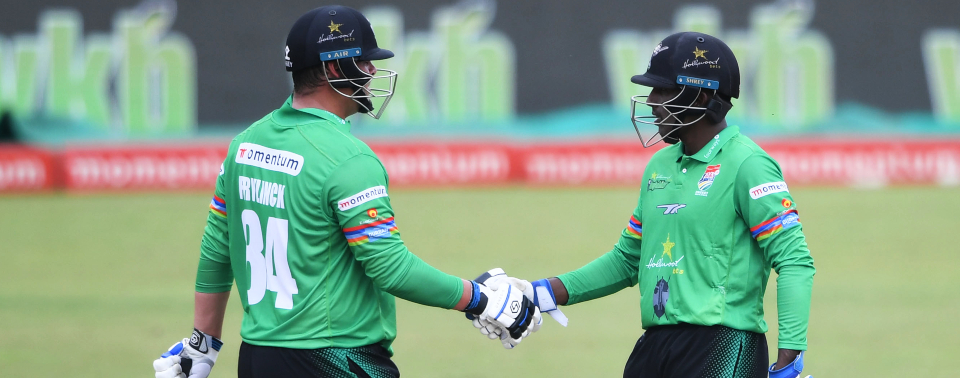
The one-day competition will have a new MVP this season as Dolphins all-rounder, Robbie Frylinck took the honours last season, capping off his career on a high. Frylinck’s 72.626 points was enough to edge out Jon Jon Smuts (Warriors) 69.811 points and Janneman Malan (Cape Cobras) on 63.794 points.

“Every season brings with it a renewed excitement as we watch the country’s best first-class cricketers strive to make their mark in all three formats of the game,” said Andrew Breetzke, SACA CEO.  This year promises to be one of the most keenly contested SACA MVP series’ we’ve ever had and we wish all the players the best in the race to the top of the MVP 2021/22 title.”
Share:

Text Info Strip

FRYLINCK AND MUTHUSAMY SECURE DOLPHINS FINAL SPOT

A well-composed all-round approach by Robbie Frylinck and Senuran Muthusamy ensured the Hollywoodbets Dolphins remained on track to defend their Momentum One-Day Cup title after they booked their ticket to Thursday’s final with a narrow three-wicket win over the Six Gun Grill Cape Cobras in Potchefstroom on Monday. 

In a low-scoring match at Senwes Park, both men took two wickets apiece to help the defending champions bowl out their opponents for just 196.  

They were then even better with the bat, sharing in a fixture record sixth-wicket partnership of 112 with half-centuries to rescue their side from 58 for five, before ensuring they chased down the target with 7.3 overs to spare. 

Veteran Frylinck did marginally better by scoring 62 off 60 balls (5 fours) and claiming two for 25 in 9.2 overs, while Muthusamy recorded 57 off 82 balls (5 fours) to go with his two for 34 in nine overs.  

The Dolphins, who won their only two matches that were completed in a rain-ravaged group stage, now await the winner of the Imperial Lions and VKB Knights last-four showdown on Tuesday ahead of the deciding game later in the week. All the matches are being hosted in a bio-secure environment (BSE) hosted by the North West town.  

Imraan Khan’s side will feel fully justified by their progress against an improved Cobras, especially after their display with the ball. 

They were superb from the time they won the toss and opted to bowl first, allowing only Tony de Zorzi to make a significant impact with this 61 off 71 balls (5 fours). 

The opener shared in a strong 81-run second-wicket stand with Jason Smith (37) and had taken Ashwell Prince’s charges to an encouraging 123 for three before he departed in the 30th over. 

That threw the Cobras into a bit of a panic as the middle and lower-order failed to make any significant impact. Only Onke Nyaku (25) managed to cross 20, with Ottniel Baartman (3/15) proving a real dangerman for the KwaZulu-Natal side alongside the likes of Frylinck, Muthusamy and captain Prenelan Subrayen (2/45). 

That left the Dolphins with a modest target, but they made a real hash of the chase by slipping into big trouble early on. 

Corbin Bosch (2/52) and Imran Manack (2/36) were made the early inroads for the Cobras to leave their opponents on the ropes by the 18th over. At that stage, only Grant Roelofsen (34) had managed to trouble the bowlers. 

However, the lower order delivered as it has done so on many occasions previously for the Dolphins. While Muthusamy dropped anchor, Frylinck waited for the bad deliveries to capitalise – the pair rebuilding and then taking their side to the brink with a record fixture stand, which broke the previous mark of 110 set by Cody Chetty and Khaya Zondo set at Durban in 2013/14.                 

By the time they were dismissed, the finish line was in sight and Subrayen (7*) and Eathan Bosch (9*) completed the job for their side. 

Share:

Text Info Strip

FICA Calls on ICC to Address Systematic Contract Breaches in ICC Sanctioned Cricket

FICA has today released its Men’s Global Employment Report 2020. The Report, covering the 2018/19 (pre-COVID-19) report period, is based on analysis of significant statistical data research, including qualitative and quantitative surveying of more than 277 current men’s professional and international players from all nine FICA member countries.

The Report follows FICA’s first men’s global employment report released in 2018 and provides an evidence-based analysis of significant issues for players and the game at a global level and across countries.

One of the key findings highlights ongoing systematic contract breaches and non-payment of players around the world in events regulated by the ICC or its members, with 32% of men’s players (34% of all players) having experienced late or non-payment issues. FICA is aware of recent late payment or non-payment issues in the following sanctioned leagues, many of which remain unresolved:

  • Global T20 Canada;
  • Bangladesh Premier League;
  • Abu Dhabi T10;
  • Qatar T10;
  • Euro T20 Slam;
  • Masters Champions League.

These are in addition to recent issues in the international cricket framework in full ICC member countries, including Bangladesh players not being paid ICC event prize money, and Zimbabwean players, for example, not being paid contractual amounts.

FICA intends to continue to release its Men’s and Women’s Global Employment Reports bi-annually and will be releasing the next edition of its Women’s Global Employment Report in the coming months.

CEO of FICA, Tom Moffat said:

“These reports continue to highlight key issues and act as a benchmark against which FICA will measure the shifting of the game’s professional player landscape and important employment and structural issues in the game.”

“Systematic contract breaches and non-payment of players are issues that urgently need addressing. The ICC has an obligation to protect people working within its regulatory frameworks and it’s time something was done about this issue.”

“We continue to urge decision-makers to work with FICA at global level, and players’ associations at domestic level, to develop joint solutions to issues highlighted in these reports, many of which are likely to be exacerbated by the current global situation.”

Jason Holder said: 

“Players should be encouraged to speak up on big issues in sport and society. With strong leadership, cricket can be a genuine force for good.”

Aaron Finch said: 

“I would love to see the role of players’ associations embraced across the whole cricket world. Player voice is important to protecting both players and the game. In my experience players care deeply about the game and want to ensure it’s healthy and thriving.”

Eoin Morgan said: 

“It’s essential the global cricket structure and leadership protects the history of the game and also its future. Domestic leagues and international cricket both have a really important place and there needs to be a balance between them.”

William Porterfield said: 

“One of the things our eyes have been opened to since forming a players’ association is that players are often the ones left on the end of the line when leagues fall over or when clubs and leagues don’t honour commitments. We hope the ICC work with FICA to properly address this.”

To access a copy of the Report please CLICK HERE

Share:

Text Info Strip

PROTEAS CONTRIBUTE TO SOLO NQWENI

The Standard Bank Proteas cricketers have pledged their support for Solo Nqweni by contributing R 50 000 towards his rehabilitation costs.

In July 2019, whilst playing club cricket in Scotland, Nqweni was diagnosed with Guillain-Barre, a rare but serious auto-immune disorder whereby the immune system attacks the nervous system. After five months in intensive care at Aberdeen Royal Infirmary hospital, Solo returned home in January to undergo rehabilitation in Johannesburg.  The cost of rehabilitation is significant and various fund-raising initiatives have been launched to assist Solo.
 
“Through the good and difficult times, players always stand together and this is no different. The decision to stand by Solo, as part of the cricket family was an easy one to make,” commented Proteas Test captain, Faf du Plessis.
 
“On behalf of the Proteas, we would like to wish Solo all the best with his rehabilitation and we hope to see him on the field in the future,” said Quinton de Kock, Proteas ODI captain
 
“We would like to thank Momentum Health, Aberdeenshire Cricket club, the Proteas cricketers and everyone that has offered their support to Solo and his family through this challenging time. We would also like to acknowledge the work of Rob Humphries (Solo’s agent) and JP van Wyk (SACA Player Services Manager) in assisting Solo over the past seven months.  SACA remains committed to continuing our support of Solo going forward” said SACA chief executive officer, Andrew Breetzke.

Share:

Text Info Strip

THE END OF AN ERA

The end of an era spanning 17 years, Tony Irish departs from his position as the founding father of the South African Cricketers’ Association (SACA). SACA was born out of a vision that sought to promote and protect the interest of players in South Africa. Over the years, SACA has evolved into a business with the sole purpose of enhancing player welfare.

SACA is an organisation with a lean staff composition working tirelessly to service and lead the way in the welfare of emerging and professional cricketers. The flagship service available to all contracted players is the SACA Player Plus programme which embodies what it means to be a modern-day professional cricketer.

SACA, under the watchful eye of Irish, has provided the necessary resources to ensure players focus on developing and achieving their life goals on and off the field. SACA’s commercial programme has enhanced player earnings potential and is always the highlight of every cricketer’s year. SACA has also maintained and negotiated an MOU, which comprehensively regulates player matters (i.e. player contracts, benefits and disputes, safety & security, etc.). I highlight the above because this is what Tony Irish has spent the better part of two decades building, developing and mastering to ensure that the interests of players in South Africa are protected and promoted.

He leaves a formidable legacy, not only for South African cricket but across various international player associations and sporting federations. Federations can take a page out of Tony’s book on how to protect the essence of not only the players’ rights but the game as a whole. Irish has always lead SACA with the players’ interest at the centre of cricket as an asset of the game. With this philosophy, any organisation stands a better chance to go further and be more profitable.

His intentions have always had the good of the players and the game at heart. He does not ask of the organisation anything he would not ask of himself. He works relentlessly smart and puts in the hours required and so much more.

I have personally learnt an enormous amount about the complexity and density of cricket administration from Tony. More importantly, the role SACA needs to play in the life of any cricketer. Tony can look back on his achievements in cricket and be enormously proud of all he has contributed to the player group and cricket in South Africa. He can stand tall of the fact that he has built a lean and mean union machines. As cricketers, we can take pride in the being members of one of the best and most modernised unions in the world.

Tony leaves our organisations during turbulent times within cricket. And I know it was not an easy decision for him and his family. I also know that he has won many fights for SACA and the players. He leaves a formidable team that is experienced, committed and cares deeply about the work they do at SACA for the players.

We take this moment to say, thank you, Tony, for all the hard work, many sacrifices and for always fighting the good fight for the players and the game. On behalf of all players in SA, thank for advancing the player cause with integrity, principle and diligence.

Thank you, and we wish you all the best on your new journey!!!

PS: Your heart will forever be green and gold. And as the summer begins against England, I know you will be shouting for the Proteas to win!

Share:

Text Info Strip

HASHIM AMLA KE SEAPARANKWE

Hashim Amla recently retired from international cricket and South African cricket lost its peaceful warrior. Hashim throughout his career became a symbol of peace, humility and nation-building in the game. His religious, spiritual and moral convictions were always on display to be examined by the world. He stood tall and firm and seldom waved from his principles. More importantly, he has a phenomenal record across cricketing formats. Personally, his test batsmanship remains the pinnacle of his excellence as he often demonstrated artistry, intelligence and mental fortitude.

Batting and fielding averages

 [table id=32 /]

I have had the privilege of sharing the field, change room, coffee, dinner and a seat with the great man himself. I remember going to the Championship with him while playing for the Cape Cobras. He was always happy to invite members of the team out for a meal. Who says no to a free lunch with Hashim Amla?

During one of our many dinners in the 2013/2014 season, I felt comfortable enough to share with him the challenges I was facing with the bat. I shared with him my challenge of constantly getting out in the thirties and asked him for guidance on how to overcome this hurdle. He asked what I felt changed when I got to thirty-odd runs? I expressed that thirty signalled to me that I could relax and the hard work of getting in was done.

He paused for a minute before responding by saying get that thought out of your head and to do the same thing that got you from zero to thirty. Moreover, apply the same principle from thirty to sixty and sixty to a hundred. He concluded the discussion by challenging me to focus on batting the whole day in four-day cricket. I accepted the challenge.

That season was my best to date!

Thank you to the mighty Hash for your contribution to my life and my game. I want to take this opportunity on behalf of all the players in South Africa and the world over to say thank you for your contribution to the game of cricket. You have touched many lives in your years of service to South African cricket.

Hashim Amla is the bravest warrior of our generation who wore the plumes of the rare bird and demonstrated leadership and heroism during his cricket career. His authenticity and character will remain the shining light of his immense contribution to the game of cricket. It is for these reasons that he deserves the highest honour awarded to the people of South Africa, through the African National Congress, for his outstanding contribution to the game of cricket: Seaparankwe. 

OR

Share:

Text Info Strip

TRADITIONAL vs MODERN CRICKET LANDSCAPES

The 2019 FICA Annual Board meeting took place in London, during the Cricket World Cup and I had the opportunity to attend and participate in the conversations on cricket globally.

FICA’s role as the global players’ representative body is to protect and promote the interests of professional cricketers around the world.

There were numerous topics discussed at the meeting, however, I want to focus on two that have a direct impact on South African cricket. The first being, the battle between traditional and modern cricket landscapes and the second is the impact of free agency on both international cricket and domestic leagues.

There are two competing landscapes within cricket globally. On the one side, there is the traditional model of cricket, comprised of existing international cricket and domestic cricket structures. On the other side, there is the modern landscape consisting of various and increasing number of domestic T20 leagues around the world.

A significant amount of commercial money in the game, namely, TV rights money, is shifting towards domestic T20 leagues and away from traditional cricket markets. Similarly, there is a significant amount of fan interest being generated by domestic T20 leagues. Critically there is a significant number of players are moving or indicating they may wish to move into, the domestic T20 leagues’ landscape.

The gravitational pull to the domestic T20 leagues is driven by the commercial value offered to players and short time commitment relative to earnings, amongst other factors such as workload and scheduling in the traditional cricket landscape. With the addition of T10 cricket and the strong foothold, the IPL has in the market, as well as other new and developing leagues, there has never been more choice for players. Players now have the opportunity to move “horizontally” around the world between short term contracts across several countries, as opposed to moving within the traditional “vertical” pathway from local domestic cricket up towards international cricket.

South African Cricket plays a critical role in the collective eco-system of international cricket. It is imperative that South Africa remains competitive, despite the decline in the commercial value of the traditional landscape. The reason for this is that the traditional model in cricket will soon become a niche market and played between governing bodies that are financially ahead of the rest in international cricket. It is in this market that South Africa will need to become a more active participant in the game and in doing so, attract the likes of India, Australia and England to its shores for 5 Test match series and eventually have a spill-over effect on ODI and T20 cricket.

For South Africa’s domestic and national players, the attraction and benefits of free agency offered in the modern landscape cannot be ignored. There are many factors globally which are driving this, including the game structure and game economics. In South Africa, the trend is exacerbated by two key factors: a volatile currency and an unstable domestic environment.

In terms of free agency in South Africa, forward-thinking suggests, if it is not carefully managed, it will likely wreak havoc in the South African cricket system much as it did in the West Indies when it was in its infancy. New Zealand’s player-centric model remains the best example of how to manage free agency and national duty. Through flexible contracting arrangements, what they have managed to do is to analyse their domestic structure to strike a balance between player earning opportunities whilst ensuring players are committed to and available for national duty when called upon.

Years before the boom of T20 leagues around the world, it was once through stellar performances at a national level that got the attention of leagues to sign players. Nowadays, players are able to showcase their skills to the international market without having represented their country. A perfect example of this in South Africa is Rassie Van der Dussen. Rassie made his mark in the Canadian Premier League, Caribbean Premier League and Mzansi Super League before representing South Africa.

Some players will continue to grow and develop within the traditional model, others will migrate to the modern model and the best will crisscross between landscapes. The challenge for cricket will be in retaining the best players within the traditional model.

As we contemplate the future let us recognize that if we fail to design a suitable and sustainable system for our needs within the global framework; this will be the beginning of the end of Cricket in South Africa as we know it.


OR


Share:

Text Info Strip

HOW WE PLAY THE GAME IN LIFE, IS HOW WE PLAY ON THE FIELD

South Africa is a country in distress. So many social ills plague our country – stagnant economic growth, high unemployment rate, underperforming sporting codes and an education system in crisis.

At any given time, sport is a microcosm of its own in society. Remember Bafana Bafana winning the AFCON in 1996 and the Springboks winning the Rugby World Cup in 1995. These were moments in our sporting history of hope and opportunity. In 1994, South Africa broke away from the shackles of the past and one could truly say we had entered a new dawn. These sporting moments capture our collective effervescence as a nation to redefine ourselves and share in a better tomorrow.

The current state of sport in South Africa is concerning particularly Bafana Bafana, Springboks and the Proteas. The momentum and energy of development programs of the 1990s seem to have fizzled away. Yet the opportunities available across major sporting codes have increased significantly. I am of the view that the current state of all these teams is interlinked to the underperformance of the economy and the challenges we face as a country. These combined issues have an interesting way of playing out in sports.

It is difficult to point out what happened in the World Cup. As the President of SACA, I firmly believed that we would be competitive and rumble with quiet confidence through the playoffs. What was evident to me and all South African fans was that the team played the out of character.

Cricket South Africa chose the best players to head to England. These 15 players had earned their place in the team however when it mattered most, the team struggled to rise to the occasion. What we saw from the Proteas team resembled the current state of the nation; low in confidence, lack of unity and ultimately a lack of gees needed to turn things around as their crisis deepened game after game.

The 2019 FICA Annual Board meeting took place in London, during the Cricket World Cup and I had the opportunity to attend and participate in the conversations on International Cricket (More detail next blog). The take-home message was that a successful and competitive Proteas team is critical to the eco-system of international cricket. This message is powerful because cricket in South Africa finds itself at a crossroads as SACA and CSA are embroiled in a legal battle about the domestic restructure and financial sustainability of the game.

Irrespective of who wins the legal battle, the most important outcome needs to be in the best interest of the game we all love. A resolution must harvest the best system for cricket and produce transformation excellence and a winning Proteas team. This will allow us to be a global competitor, transformative and financially sustainable.

I’m not one for sharing problems without solutions. What we need in Academics, Sports & Arts and Culture is:

Nationally: Excellent coaching, high-performance focused and a transformed, globally competitive team.

Domestically: A competitive domestic structure that is financially sustainable without government funding. And a structure that promotes excellence from administration to the field.

Youth: The biggest challenge for sport in this country rests in the low levels of participation by the youth.

Sports, Arts and Culture have to be re-integrated in the school curriculum (also known as ‘The Holy Trinity’). If the government can redesign the curriculum in this way the future of the sport in this country is destined to succeed! This has many positive spin-offs namely; crime reduction, drugs and alcohol abuse reduction among the youth and job creation within schools for coaches within Sport, Arts and Culture departments.

The reality is, this model already exists in our country where only those with access to financial assistance are able to enjoy its benefits. The government needs to adopt and support this model for public schools and the rest is history.

OR

Share:

Text Info Strip

PROTEAS RUMBLE TO VICTORY

South Africa has announced its ICC World Cup squad (team below). Naturally, some players are delighted others understandably disappointed. However, the focus now turns to this group of players who have been tasked with the national responsibility of bringing the World Cup trophy home for the first time.

South Africa’s history at World Cups is gut-wrenching and has always produced moments of the highest drama and occasions never to be forgotten. The most prominent ones must surely be the semi-finals of 1999 in England and 2015 in New Zealand. On both occasion we were so close, yet so far! I guess the most disappointing factor was always that South Africa had entered both competitions as firm contenders, if not outright favourites to win the World Cup. This time around, South Africa enters the 2019 ICC World Cup certainly not as firm favourites and, perhaps, not as settled as before in their build-up to the event.

This unchartered territory for South Africa is a positive for the team. They will have an opportunity to focus solely on their preparation without the external pressure of expectation. That is certainly my wish; after all, the South African public sets such high expectations for all their teams. Naturally, the public will, once again, be expecting South Africa to win the competition, in which case we should not be surprised when the ‘chokers tag’ rears its ugly head as a tactical ploy by the opposition to impose themselves on the Proteas.

This will always be a mental hurdle for the Proteas team to overcome if they are to make history and win the tournament for the first time.  In order to overcome the label, the team will have to rumble with vulnerability. This means, according to renowned Research Professor Brene Brown, “having the courage to show up fully when you can’t control the outcome.” It is about being vulnerable in their relationships as teammates on a daily basis which means sharing their excitement and fears openly together. In fact, we, the public, will also rumble with vulnerability, with and for the team.

One of our great assets going into this World Cup is that South Africa has a courageous leader in Faf du Plessis.  He lives the values of #Proteafire and is never silent about the hard things. He is the kind of leader who is willing to step up, put himself ‘out there’ and be courageous. Brene Brown argues that “the greatest barrier to courageous leadership is not fear – it is how we respond to our fear.” Together with his leadership group, Du Plessis embodies a collective sense of calm and determination to cultivate a culture in which brave work, tough conversations, and whole-hearts are expected. Moreover, he is tactically shrewd and strategically on par with the best in the world.

The environment cultivated by his leadership will unleash the likes of, Kagiso Rabada, Quinton de Kock, Andile Phehlukwayo and the rest of the Proteas because they will feel safe, seen, heard, and respected. This team has a wonderful mixture of youth and experience which, I believe, will provide a competitive advantage during the tournament. The Proteas is an iconic brand around the world and we know the team will be exemplary compatriots in England.

On behalf of the players, SACA, and myself as the President of the Association, I want to take this opportunity to wish the Proteas well in their quest for gold, may they rumble to World Cup victory.

World Cup Squad: Faf du Plessis (C); Quinton de Kock (Wk); Hashim Amla; Aiden Markram; Rassie van der Dussen; David Miller; JP Duminy; Dwaine Pretorius; Dale Steyn; Kagiso Rabada; Lungi Ngidi; Chris Morris; Andile Phehlukwayo; Imran Tahir; Tabraiz Shamsi


OR

Share:

Text Info Strip

MZANSI SUPER LEAGUE ANNOUNCES FINALISED T20 SQUADS

The inaugural Mzansi Super League (MSL) T20 Player Draft was held today at Montecasino in Johannesburg today.

Each team had already been allocated a Marquee Standard Bank Protea player. Today the teams made their picks from the six International Marquee Players and then filled the remaining 14 places in each squad from the foreign and South African players who had applied to enter the draft.

In the mini-round to select the International Marquee Players, the Durban heat had first call and went for Rashid Khan of Afghanistan, the No. 1 ranked bowler in the current ICC T20 rankings. They were followed by the Jozi Stars who went for Chris Gayle of the Windies. Paarl Rocks followed with another Windies player, Dwayne Bravo. Cape Town Blitz then took Dawid Malan of England followed by Tshwane Spartans with England white ball captain Eoin Morgan and Nelson Mandela Bay Giants with England opening batsman Jason Roy.

In round one proper, the Giants led off with Chris Morris, followed by the Spartans with Lungi Ngidi, the Blitz with Andile Phehlukwayo, the Rocks with Tabraiz Shamsi, the Stars with Kolpak star Dane Vilas and the Heat with David Miller.

Lutho Sipamla became the first rookie to be chosen in Round Eight by the Spartans and they followed with another rookie in Tony de Zorzi in Round Nine. Other rookies signed were Sinethemba Qeshile for the Stars, Dyllan Matthews for the Giants, Okuhle Cele for the Heat, Eathan Bosch for the Rocks, and Kyle Verreynne for the Blitz.

The resulting teams are a unique blend of both local youth and international experience which is sure to make for some very exciting cricket.

The Draft order was predetermined by a weighted Player Matrix system. The players who are eligible for the main Draft are those who entered into a binding agreement to enter the Draft.

FINAL SQUADS

(in order of Protea Marquee Player, International Marquee Player, and then the 14 draft rounds, making a total of 16 players per squad)

CAPE TOWN BLITZ: Quinton de Kock, Dawid Malan (England), Andile Phehlukwayo, Dale Steyn, Samuel Badree (Windies), Asif Ali (Pakistan), Farhaan Behardien, Anrich Nortje, Janneman Malan, Malusi Siboto, George Linde, Ferisco Adams, Jason Smith, Sibonelo Makhanya, Kyle Verreynne (rookie), Dane Piedt.

DURBAN HEAT: Hashim Amla, Rashid Khan (Afghanistan), David Miller, Heinrich Klaasen, Kyle Abbott (kolpak), Keshav Maharaj, Khaya Zondo, Albie Morkel, Marchant de Lange (kolpak), Vernon Philander, Brandon Mavuta (Zimbabwe), Temba Bavuma, Morne van Wyk, Okuhle Cele (rookie), Sarel Erwee, Tladi Bokako.

JOZI STARS: Kagiso Rabada, Chris Gayle (Windies), Dane Vilas, Rassie van der Dussen, Daniel Christian (Australia), Beuran Hendricks, Reeza Hendricks, Dwaine Pretorius, Eddie Leie, Pite van Biljon, Duanne Olivier, Ryan Rickelton, Sinethemba Qeshile (rookie), Simon Harmer, Calvin Savage, Alfred Mothoa.

NELSON MANDELA BAY GIANTS: Imran Tahir, Jason Roy (England), Chris Morris, Jon-Jon Smuts, Junior Dala, Christiaan Jonker, Aaron Phangiso, Ben Duckett (England), Sisanda Magala, Ryan McLaren, Heino Kuhn, Marco Marais, Dyllan Matthews (rookie), Lizaad Williams, Rudi Second, Carmi le Roux.

PAARL ROCKS: Faf du Plessis, Dwayne Bravo (Windies), Tabraiz Shamsi, Dane Paterson, Aiden Markram, Mangaliso Mosehle, Bjorn Fortuin, Vaughn van Jaarsveld, Grant Thomson, Paul Stirling (Ireland), Tshepo Moreki, Henry Davids, Cameron Delport , Eathan Bosch (rookie), Patrick Kruger, Kerwin Mungroo.

TSHWANE SPARTANS: AB de Villiers, Eoin Morgan (England), Lungi Ngidi, Robbie Frylinck, Jeewan Mendis (Sri Lanka), Theunis de Bruyn, Rory Kleinveldt, Sean Williams (Zimbabwe), Gihahn Cloete, Lutho Sipamla (rookie), Tony de Zorzi (rookie), Dean Elgar, Andrew Birch, Sikandar Raza (Zimbabwe), Shaun von Berg, Eldred Hawken.

Share:

Text Info Strip

FICA RESPONDS TO RELEASE OF ICC FUTURE TOURS PROGRAMME

The Federation of International Cricketers’ Associations (FICA) responds to yesterday’s release of the men’s Future Tours Programme 2018 – 2023 (FTP).

“It is a positive that this FTP is structured to fit with the introduction of a nine team World Test Championship and a 13 team ODI League,” said FICA’s Executive Chairman, Tony Irish. “It is hoped that the World Test Championship and the ODI League will introduce much needed context into international cricket.”

“We think that the scheduling of the ODI League represents a significant step forward because it reflects that the global competition can only consist of three matches per series, which makes it simple for fans to follow and cuts out meaningless ODI matches. We continue however to urge the ICC to develop a clear pathway for smaller and associate countries to participate in this League.”

“The World Test Championship does not have the same degree of consistency in the scheduling and different series constitute different numbers of matches depending on who is playing, which will make any points system a challenge to follow. Whilst it’s an improvement on what currently exists, and the culmination in a Test final every two years does add context, time will tell how effective this will be as a global competition scheduled in this way.”

FICA notes that the FTP does not formally recognise domestic T20 leagues or provide for any international cricket windows. “One of the global game’s current challenges lies in the tension between the traditional international cricket landscape and the T20 leagues landscape,” said Irish. “This problem can’t be solved by simply restricting players from playing in T20 leagues and FICA will continue to oppose any attempts to unfairly regulate or to restrict players if used as a means of attempting to solve inherent imbalances in the structure of the game.”

“So whilst this FTP is definitely a step in the right direction, we are hoping that it will be viewed as a first wave of reform in the global game” concluded Irish.

Share:

Text Info Strip

ICC INTRODUCES CHANGES TO CODE OF CONDUCT

The International Cricket Council has introduced changes to the ICC Code of Conduct for Players and Player Support Personnel, effective 22 September 2016.

There has been no change to the list of offences in the Code of Conduct, or the current penalty regime of warnings/fines/suspensions applicable to each offence, but players who have breached the Code will now also accumulate Demerit Points, which can see repeat offenders suspended. Demerit Points will remain with a player for two years, and all players will start with a zero balance from 22 September to coincide with the introduction of these changes.

The new ICC Code of Conduct for Players and Player Support Personnel can be read here, with the changes confined to Article 7 of the Code.

The new DRS playing conditions relating to the LBW ‘Umpire’s Call” will also come into effect on 22 September, with the first match to be played under these regulations the ODI between South Africa and Ireland in Benoni on Sunday.

Share:

Text Info Strip

OUTCOMES FROM THE ICC ANNUAL CONFERENCE

The 2016 ICC Annual Conference concluded on Saturday in Edinburgh with the ICC, IDI and IBC Board meetings, which were held under the chairmanship of Mr Shashank Manohar.

Among the discussions held, decisions made and reports received were:

Significant progress made in the ongoing review of the ICC’s governance structure

The Board noted with satisfaction that significant and positive progress had been made by the working group established to oversee a complete review of the 2014 resolutions and constitutional changes.

The Board was informed that a draft of a new constitution will be prepared in the coming weeks for consideration by the Board at its October meetings.

ICC Chairman Shashank Manohar said: “We have undertaken the responsibility of reviewing the 2014 resolutions and constitutional changes in their entirety as we are committed to following best practice principles of good governance to build, improve and enhance the image and reputation of the ICC by putting in place systems and processes which are fair, transparent and merit-based.

“I am pleased with the work that has been done to date and during this set of meetings and we are looking forward to presenting the amended constitution to the Board for its consideration at the next meeting.”

International cricket structures

In parallel to the discussions around governance structures, the ICC Chief Executives’ Committee held constructive discussions about the structure of international cricket and the establishment of new competitions in all three formats. Members were updated on the progress of the project, and all understood that more detail is needed before any final decisions can be made.

It was proposed that a workshop be scheduled in early September in Dubai to facilitate discussion between Members on this project, and to work through some of this detail.

ICC Chief Executive David Richardson said: “This is an unprecedented opportunity for our sport to introduce a package of bilateral international cricket structures, which are merit and performance based, have context, enhance the value of bilateral international cricket and create a highly competitive environment for cricketers so they can provide more entertainment to spectators.

“The Member countries acknowledge and recognise the importance of international cricket across all its three formats and are committed to ensuring that it continues to grow in relevance and value for cricket fans around the world.

“This is a complex issue on many levels but I am heartened by the progress that has been made to date and during these meetings and look forward to the next meeting in Dubai.”

ICC agrees to support the inclusion of a women’s cricket event in the 2022 Commonwealth Games

Following a presentation by the Commonwealth Games Federation, the Board has decided to submit an application for a women’s cricket event to be included in the 2022 Commonwealth Games in Durban. As well as creating an opportunity to showcase the remarkable progress of female cricket on a global stage, this will provide top female cricketers with an opportunity to feature in an additional high profile competition.

The ICC will now work closely with the Commonwealth Games Federation in order to ensure cricket’s inclusion on the program and to determine the specific tournament structure and qualification process that will be applied.

Mr Manohar said: “The Board has taken a strategic decision to support the inclusion of women’s cricket in the 2022 Commonwealth Games as it will enhance the profile of the sport and create additional exposure and experiences for female cricketers, as well as opportunities to engage with the Commonwealth Games on important social justice issues and initiatives.”

There will be further discussions on cricket’s potential participation in the Olympic Games following further meetings with the International Olympic Committee later in the year.

DRS – Umpire’s Call

During its meetings, the ICC approved a change to the DRS playing condition relating to the LBW “Umpire’s Call”. The size of the zone inside which half the ball needs to hit for a Not Out decision to be reversed to Out will increase, changing to a zone bordered by the outside of off and leg stumps, and the bottom of the bails (formerly the centre of off and leg stumps, and the bottom of the bails).

This amendment will come into effect from 1 October (or from the start of any series using DRS that commences just prior to this date).

No balls

There was discussion about the calling of No balls, and the ICC will arrange a trial over coming months to better understand whether the third umpire could use instant replays to call No balls more accurately. The trial is likely to be staged during one of the upcoming ODI series, and the third umpire will judge No balls within a few seconds of the ball being delivered and communicate this to the on-field umpire. Further details relating to the trial will be announced once finalised.

Helmet Safety

The ICC reiterated its position that the wearing of helmets in international cricket should not be mandatory, but that if a player decides to wear a batting helmet, then it must comply with the new British Standard (BS) – BS7928:2013.

There was concern that there were too many international cricketers not wearing BS compliant helmets, and that this needed to be more tightly regulated by the ICC. It was agreed that Members will educate their players on the benefits of using BS compliant helmets, and the ICC Clothing and Equipment Regulations will be amended to reflect the decision that only BS compliant helmets may be worn when batting in international matches.

“The discretion of wearing a helmet continues to rest with the player, but if a player decides to wear a helmet then it has to be one which complies with the British Standard specifications. This is part of ICC’s duty of care to prevent a player from picking up a serious injury as a result of a misperception that the helmet being worn is safe,” said Mr Richardson.

Other matters

The Chairman of the Anti-Corruption Unit, Sir Ronnie Flanagan, provided an annual update, including the progress made on the implementation of the Integrity Working Party recommendations, which were approved during last year’s ICC Annual Conference in Barbados.

The Board also approved the extension of the ICC Chief Executive’s contract, with Mr Richardson agreeing to continue in the role through to the end of 2019 ICC Annual Conference.

Cricket Scotland thanked

Mr Manohar described the 2016 Annual Conference as a huge success and thanked Cricket Scotland for hosting the summit. “It has been a memorable gathering with many highlights throughout the week as well as being a highly productive period for all of the administrators in many ways. With the overarching aim to make cricket The World’s Favourite Sport, we have addressed and tackled a number of important matters, strengthened old relationships and made new friendships.

“Some of the most significant projects remain work in progress but they are complex and require considerable attention and thought. Even in these areas, we have made big strides and I remain confident and optimistic that we will conclude that work as quickly as possible.

“On behalf of the entire cricket family, I want to thank Cricket Scotland for hosting this year’s Annual Conference in Edinburgh and for being an outstanding host. I wish Cricket Scotland all the very best both on and off the field,” said Mr Manohar.

Share:

Text Info Strip

PROTEAS SLIP DOWN THE ICC TEST RANKINGS

Australia have opened up a six-point gap over India at the top of the ICC Test team rankings. This follows the annual update with the results from 2012/13 no longer included in the calculations and outcomes from the 2014/15 series weighted at 50 percent.

India now lead third-placed Pakistan by just one point. Pakistan have benefitted from the annual update as defeat against South Africa, 3-0, in 2012/13 no longer counts, while the 2-0 loss to Sri Lanka in 2014/15 has its weighting reduced to 50 percent.

The annual Test update has resulted in South Africa dropping from third position to sixth after conceding 17 points. This is due to South Africa’s victories over England, Australia, New Zealand and Pakistan in 2012/13 all being dropped from the rankings calculations.

The annual update has also affected the West Indies, who have retained their eighth position but have dropped from 76 points to 65 points. This is because their victories over New Zealand, Bangladesh and Zimbabwe in 2012/13 have all been dropped from calculations.

The gap between the West Indies and ninth-ranked Bangladesh has been slashed from 29 points to just eight points.

With Sri Lanka and Pakistan set to visit England for three and four Tests respectively, Australia travelling to Sri Lanka in July for three Tests and South Africa hosting New Zealand in August for two Tests, the series outcomes may well result in significant movements on the team rankings.


Share:

Text Info Strip

FINDING THE RIGHT FIT

Glen Addicott has always had a passion for what he does. Rather than investing all that passion into his work as a cricketer in an often unpredictable landscape, he found another area into which he could channel his energy.

Four years ago a new challenge in his cricket career seemed logical for Pietermaritzburg-born Glen Addicott. After seven seasons as a regular for KwaZulu-Natal Inland, the top-order batsman had only played a handful of matches for the Dolphins in 2010-11 and 2011-12, so he felt the timing was right for a move to South Western Districts to explore further playing opportunities.

“My former club coach from Maritzburg Varsity, Gary Hampson, had moved down to the area to coach SWD and offered me the chance to join them, which I did,” the 31-year-old says.

As it turned out, ’real life’ caught up quickly for Addicott in the Southern Cape.

“I came down to George in 2012, then in February 2013 married to Jesse Ann and then she fell pregnant. All that meant I became quite keen to settle down. While I was still in Maritzburg I had spent a year studying towards a Bachelor of Business Administration, my degree wasn’t complete. I had also done Level I and Level II coaching courses but that’s not what I wanted to do.”

Fortunately, Addicott had already been introduced to a long-term career option in which he was interested.

“In 2011 I was playing club cricket in England [for Vauxhall Mallards, based close to the east coast of England] and one of my mates was also a personal trainer. He was training a guy with polio and invited me to join them at a CrossFit box – that’s what their ‘gyms’ are called. Being fully fit I thought it would be easy, but the session broke me and from that day I knew I wanted to do CrossFit. Basically, CrossFit is all about functional movement, which comes from a split between gymnastics, weight lifting and cardio work, which could be riding, running or swimming. Also, every day is different and varied and it’s performed at high intensity. It’s one of the fastest growing sports in the world and has its own CrossFit Games.”

To turn that interest into a career, Addicott tapped into the resources available to him, starting with SACA Personal Development Managers, Ruan Schlebusch and Brad Player.

“Ruan helped me draw up contracts, come up with a business plan and enrol in various classes to own a CrossFit box. Brad was also great, and even these days he often pops in for coffee and a chat.”

Addicott also found a willing business partner in his SWD captain, Ross McMillan, with whom he has come a long way.

“Ross and I have known each other for many years,” he says. “We grew up playing cricket against each other [McMillan for Hilton College and Addicott for St Charles College], and then together in numerous teams, such as KwaZulu-Natal Inland and then SWD. Ross has always been business-minded and had a desire to run a business. I, on the other hand, am not naturally that way inclined and so my skills lay in the programming and coaching of classes. We made a great team.

“That said, in June 2015 a great opportunity arose for Ross and he left us, and retired from cricket, to pursue a career in the financial sector [as a Financial Planner with Momentum] – a fantastic move for him and a certain loss for us. Although we miss him, I have learnt some wonderful business skills and thus am very happy with how things are going at CrossFit George.”

Having now gone it alone, how does Addicott look back on the decision to put his kit bag in storage?

“It was a tough decision. Cricket was my life and I didn’t have any other job. However, it was also a pretty easy decision in the sense that I’m still involved in sport and people. The major difference is that when you own your own business it’s 24-7 while with cricket you get lots of down time. So the business side has been a bit of a change.”

However, he confirms that he’s in it for the long run.

“My parents and my wife’s parents have moved down here [no doubt to be closer to their granddaughters, born in 2013 and 2015]. Personally, it was tough in the beginning with early mornings and late evenings for classes but here in George the life is great, there’s very little to complain about. I do miss cricket but I’ve fallen into another passion.”

Share:

Text Info Strip

THE ROAD LESS TRAVELLED

Success. Failure. Disappointment. Perseverance. Dreams. These words begin to describe the journey Kevin Bennett has been on to achieve his objectives.

Kevin Bennett has played for Border since making his debut in the 2005-06 season, but has spent a significant portion of that time as a non-contract player. As a result the 34-year-old batsman has doggedly pursued opportunities outside of cricket.

“In 2001 I started studying at Rhodes University and then moved to NMMU [Nelson Mandela Metropolitan University], but it didn’t work out at either. At Rhodes, I was involved in a confrontation and was excluded during my second year. The following year I moved to NMMU where I played hockey and cricket, but in my second year in Port Elizabeth I couldn’t afford to continue my studies. I was living in an expensive flat in Summerstrand and I was paying for my studies, so I ended up going home where I continued my BCom Economics degree through Unisa while working.”

Back home – and with his ‘wild and loose’ persona behind him thanks to his newfound Christian faith – Bennett made his provincial breakthrough and managed to complete his degree, the first in his family to do so. Those efforts did not go unnoticed and culminated in an invitation to another learning institute in 2007.

“My brother Bevan was studying at and playing for the University of the Western Cape and I was invited by Advocate Nick Kock to come and play there too. Nick, who ran a life skills programme called Sport Skills 4 Life Skills, which encourages guys from disadvantaged backgrounds to play cricket and get an education, wanted me to do a post graduate course there and inspire other students to take their studies seriously.”

His time in the Cape ended up being quite busy as he was balancing the demands of doing a post graduate certificate in education whilst lending a hand at two other learning institutions.

“I worked at MSC Business College in Bellville [as he had done in East London] and concurrently lectured at Damelin College in Somerset West.”

Things were about to change.

“My fiancée was still in East London. We wanted to relocate but she struggled to find a job in Cape Town and in the end I decided to move back home. I applied to some schools and got a job at AW Barnes Primary in Parkside. That was in 2010, and I’ve been teaching there ever since. The school is surrounded by Second Creek informal settlement, and because I’m passionate about community development I’ve tried my best to help the kids, and the community, see that there are opportunities out there for them.”

Bennett understands the value of being given an opportunity to succeed. He and his twin brother Bevan do not come from an affluent family, and it was thanks to sports scholarships that they attended Selborne College where Bevan now teaches and coaches cricket. It was with this in mind that Bennett approached SACA to broaden his horizons even more.

“I remember players going to SACA meetings, but my first real involvement was when I approached Melonie Gobel [SACA’s East London-based PDM] to ask if I could do an MBA. She asked me to get the documentation from Mancosa and said that we would take it from there. I had to pay my registration fee and then, if I passed, SACA would cover my tuition fees.”

It is well known that doing a Masters in Business Administration (MBA) course is extremely demanding, so what was Bennett’s experience?

“Everyone said it would be so difficult, and that it would be almost impossible as a husband, father, teacher and a cricketer, but I’ve got through it and all of those things are still intact, and I am still intact. The highlight for me is that I tested my limits and I now know that I have a work ethic I never had before.”

So, no stressful times?

“The last two to three years were very difficult because I haven’t slept much, I’d wake up at three in the morning, study, then go to work, then find ways to train whether it’s a run or hitting some balls before studying some more and going to bed late. My wife Haylee was brilliant because she handled everything to do with our son Micah, who was two when I started studying. There were one or two arguments when I couldn’t fulfil certain responsibilities, like changing nappies, but in a sense the lows turned into highs because making up after an argument actually brought us closer together.”

Bennett is grateful for what cricket has afforded him.

“In cricket you have to manage success and failure. You have to find a happy balance. Personally, it took me some time to get that right. I was speaking to a guy recently who asked me why I chose cricket over hockey. His point was that success is never guaranteed in cricket but I told him the beauty of cricket is that it’s like no other game because it teaches you things that you need in life. It teaches you patience, how to deal with difficult people both within and outside of your team; it teaches you about dealing with people from different backgrounds, especially in the case of a team like Border. It’s such an amazing team because you play with guys who are from rural areas. Some don’t even live in a house but they’re playing cricket. It’s been such an enriching experience watching guys in situations like that still have the fight in them to win no matter where they come from.”

There is no doubt that Bennett himself has put up a similar fight.

Share:

Text Info Strip

CHOOSING HIS TIME

When a cricketer leaves the game at 25, history suggests that they don’t do so on their own terms… not so for Dale Deeb.

By the time Dale Deeb had turned 25, his cricket CV was quite impressive. During high school at Trinityhouse in Randburg, he made SA Schools teams two years in a row, the highlight being captaining the 2008 side that included Temba Bavuma and Titans players Graeme van Buuren and Mangaliso Mosehle. After school, the spinning all-rounder represented SA Under-19 against England in 2009 before earning his breakthrough at the Highveld Lions via provincial cricket for Gauteng and North West. As has become popular with local cricketers, he’d also done a stint playing club cricket in the United Kingdom in 2012. However, by the end of the 2014-15 season Deeb chose to focus more on his work CV.

“It was a huge decision,” he admits. “Firstly, I was 25 but couldn’t really support myself on the contract I was being offered. Also I got to a point where I’d done everything I could for two seasons and was playing some of my best cricket, but wasn’t really getting any chances with the Lions. Ultimately, I also had something to fall back on.”

Deeb had already experienced a challenging period of studying

“I started off studying at the University of Johannesburg, but once I was contracted it just became too hectic. I was all over the country and it was too busy for me to even attend lectures. Then I went overseas, and when I got back I decided I needed to continue studying to get a degree. At UJ I studied B.Com Finance, but switched to B.Com Economics when I moved over to Unisa in 2011.”

As it turned out, studying part-time tested all of Deeb’s resolve.

“It required a lot more discipline, because if you don’t put in the time you’re not going to pass. One of the things I discovered that helped me was to do more subjects in winter when you have more time. In summer, during the season, I’d do three or four subjects, and then in winter I’d do six. I would still get my assignments and cram them in, but for three weeks during winter I’d put in eight or nine hours every day to work towards my exams.”

Finding Deeb with his books while padded up, or in stadium function rooms, or alongside regular roommate Nicky van den Bergh (himself studying towards his LLB at the time) became a common occurrence.

“I really put my head down in the last couple of years of studying and managed to finish my degree in 2015,” he says.

In the interim, Deeb also explored some business interests, initially getting involved with a business that erected, rented and sold scaffolding.

“We were bought out, so I’m currently involved in a company called Solid Ceiling Products with two partners. We import ceilings and partitioning for offices in commercial spaces and houses, and employ about 14 people in Johannesburg and Durban.”

Essentially it was Deeb’s need to get more hands-on that sealed his decision to move into the business full time.

“It wasn’t a case of when I get my degree, I’m going to stop playing cricket. It was more a case of weighing up the degree I had against the business I was in and what would be more meaningful for me in the long run – what would present me with a better future. It’s obviously been an adjustment working in an office rather than being on the field, but it’s all part of growing up – even if I do sometimes miss cricket.”

While financial considerations played a role in him transitioning out of cricket, Deeb highlights the challenges cricketers face.

“Yes, it had a lot to do with financial considerations, but I also felt it was the right time because I could commit to a long-term plan. There is no certainty in cricket. I needed more security or communication to stay patient, because I wanted a long-term future.”

And while Deeb is not even turning out for his old club, Wanderers, it’s not because he’s fallen out of love with the game.

“I’m loving working and doing what I do, but also having my weekends free. Maybe in time I’ll play a bit again, but when I look back I had seven years that I loved playing. I had an absolute blast in the last three years and ended with my best season [He was awarded the 2014-15 Provincial Three-Day Player of the Season]. Also, I felt I’d done everything I’d set out to do. I wanted to take 200 first-class wickets, and I did that. I also wanted to become an all-rounder, and in the last few seasons I averaged 30s and 40s with the bat.

“Overall, I’m happy about starting something new and being positive about it. The timing was right.”

Share:

Text Info Strip

DEVELOPING ALL-ROUNDERS

Cricketers’ on-field careers can last only so long, which is why SACA takes its role in developing well-rounded people seriously.

After the establishment of the Player Plus programme in 2008, it was imperative for SACA to find the right partner to help the programme achieve its goals – offering comprehensive personal development, education and support for their members.

Fortunately, a suitable life skills partner was not hard to come by. While the Sports Science Institute of South Africa (SSISA) has been at the forefront of fine-tuning the physical and mental requirements of elite athletes, they had not neglected the fact that performance is influenced by off the field factors too – be it personal, lifestyle or environmental.

As Gill Taylor, the Education, Training and Development Manager of SSISA, says, “Our extensive research shows that the most successful athletes or players globally are those who have a balanced approach, and who take ownership of what they’re doing in all aspects of their life. It’s not about the cricketer, but the person beyond that.”

Through SSISA’s Macsteel Maestros initiative, primarily a CSI programme which focusses on disadvantaged athletes, Taylor and her team of mentors around the country have built up a well of relevant content.

“We deal with three pillars in the life skills landscape. The first pillar is personal growth skills, things like communication, ethics, values, diversity… I sometimes call them the ‘touchy-feely’ aspects. Second is self-management and those are the practical issues in a player’s life like do they have a will and a tax number, or do they understand time-management. We also have a module that deals with taking responsibility, drinking responsibly and substance abuse – those types of things. Then finally, we look at professional skills which includes dealing with media, social networking and nowadays linked to that is a dual career programme.”

Often the main question when trying to engage professional sportsman, especially on topics not directly related to their sport, is ‘how?’.

“When SACA approached us saying they were looking at working more closely with the cricketers, one of the things emphasised was that it had to be a relationship-based programme. It’s no good just saying to a player that if they need a psychologist they should go and see one, they need somebody they can confide in, build a relationship with and with whom they are able to discuss any aspect of their life.”

This is why it was decided that each franchise would have a Personal Development Manager (PDM), who would not only deliver workshops to a team but also engage in one-on-one sessions. In group sessions, topics would also be to-the-point rather than broad.

“Topics range from self-confidence and respecting differences, to conflict-management and teamwork. Many of the team workshops lead from or are followed up by individual sessions. You need to know what the team’s goals are and then create a synergy, like if we’re doing a session on communication it has to be done in a team dynamic.”

Taylor says that their research and feedback has also delivered some interesting insight on the effectiveness of the life skills sessions they’ve conducted over the years.

“The research we did showed that when doing life skills sessions, there’s an increase in critical thinking, which is what creates behavioural changes. Encouragingly, coaches have given feedback that they feel their teams have played better after life skills sessions.”

Taylor explains why a healthy player-PDM relationship is important.

“Initially the players were wary of the PDMs, wondering whether they were there to feed back to their coaches or selectors. Nowadays it’s completely understood that they’re there to meet the players’ needs. There is now a healthy trust relationship between players and PDMs. Players are particularly receptive when they’re injured, have had a change in family situation or nearing retirement but a big focus area for us will also be the other transition period, when players first leave school and are met by things like contracts, free time and female attention.”

The identification of suitable, qualified PDMs is crucial to the success of the programme.

“We were fortunate that when SACA partnered with SSISA we already had a group of experienced PDMs at our disposal. By that time they had already been with us for about eight years so they understood what sportspeople go through. They do this secondary to their other jobs. We usually look at people who’ve been in the field and who are able to view things objectively.”

As they do with players, PDMs are also continuously given opportunities to enhance their skills and knowledge.

“They get training annually. All of them went through an accredited course on career assessment and advice; then every year we give them new modules to work from for life skills training and there is constant liaison between them and myself, and Ruan Schlebusch, the National SACA PDM Manager, with regards to the life skills programmes. What helps is that they bring to us the topical issues which players talk to them about and then we change things accordingly.”

Having worked with other sports bodies, Taylor is greatly encouraged by the benefits cricketers are receiving off the playing field.

“Many sports tend to only do one-off programmes whereas the Player Plus programme engages with players through the PDM-player relationship on an ongoing basis. There is regular evaluation of player needs and appropriate action to cater for it. It’s harder to get through to the players in cases where you engage once-off, so we’re really happy with the partnership we have with SACA. Hopefully other sports will follow their example…”

Share:

Text Info Strip

DUAL CAREER. DUAL SUCCESS.

Can you become a Proteas player while studying? Temba Bavuma provides the answer…

When Temba Bavuma scored his maiden Test century against England in January, all the headlines were about him becoming the first ethnic black South African to do so.

Less heralded was the interesting fact that he proved that chasing dual career objectives need not affect cricket performance – he finished his degree in 2014, the same year he was selected for the Proteas against West Indies.

The seeds for the 25-year-old batsman doing tertiary education were sown during his high school years. Bavuma started Grade 8 in 2003 at SACS in Cape Town, then spent the following year at Fourways High when his family moved to Johannesburg before completing school at St David’s Marist Inanda after receiving a cricket scholarship.

He passed matric in 2007, but he then decided to do post matric in the year he turned 18.

“Doing post matric was mainly from a cricket point of view as I didn’t want to get lost in the system being only 17. [He had only made the SA Schools Colts team in his actual matric year, but then went on to make the Gauteng provincial side before SA Schools and SA Under-19 selection after the 2008 Coca-Cola Khaya Majola Cricket Week] Academically, it basically reinforced all the knowledge that I had. St David’s didn’t actually have post matric, so I just redid subjects and reinforced my marks.”

In so doing, Bavuma achieved three distinctions, one of which set the platform for what he wanted to study.

“When I finished school, I knew the importance of getting a qualification to be able to have a career outside of cricket – my parents always stressed the importance of education. Accounting had always been a favourite subject of mine, so I knew I wanted to go into finance.”

So in 2009, Bavuma registered for a BCom Financial Management degree at University of Johannesburg. Eighteen months later though, he dropped out – the demands of full-time tertiary education not mixing well with his burgeoning cricket career.

“For me it was quite hard initially to find the balance between cricket and studying. With cricket we’re travelling a lot and some days after a game I’d be studying until one or two in the morning… that was quite tough.”

As it turned out, it was his progress in professional cricket that proved pivotal in him finding the right balance.

“In 2012 I became a SACA member and one of the main benefits for me was related to my studies through the Player Plus programme and the financial point of view. SACA awarded me a bursary to restart my studies through Unisa. What also helped was the close contact with my SACA PDM, Mary-Jane Goebel. We spoke frequently, and she would check on my progress and help me with anything I needed. I was motivated in what I was doing but her help was important.”

Bavuma confirms that he’s never regretted his decision to target dual career goals.

“I’ve missed a couple of exams because of cricket and sometimes walked straight onto the field after writing an exam but I’ve always enjoyed studying. It’s had a positive effect on my cricket as it takes my mind off the game. When the Player Plus programme was presented to us I didn’t have an idea of the kind of benefit it would have for me. Looking back now, and particularly having somebody like Mary-Jane to throw ideas at… she’s been like a mentor throughout the process and has really assisted in helping me get through my degree which I finished in 2014.”

A further off-field interest, beyond his regular house music DJ sessions with his friends, is Bavuma’s involvement with a cricket coaching programme at his alma mater and his role in organising the annual Langa All Day Festival of Cricket, held over the festive period.

“Langa is a place I hold close to my heart as it was where I was born and grew up. We [fellow Langa-born professionals Thami Tsolekile, Malusi Siboto, Siya Simetu and Nono Pongolo are also involved] organise the festival as basically a day to unite the community where they can enjoy themselves in sport. This past year we had about 3500 supporters whereas the first edition had about 2000 – so the day is growing thanks to sponsors like Kookaburra, KFC, Score and Cricket South Africa.”

As it is, while Bavuma chases further honours with the Proteas, he is determined to do the same off the field too…

Share:

Text Info Strip

TRADING PLACES

At 33, Warriors bowler Lundi Mbane has worked long and hard at his trade, but has also been preparing for his next one…

Even before Lundi Mbane began his professional cricket career with Border in 2004, he had an introduction to what his long-term career might entail – thanks to his father…

“At an early age my father taught me how to weld, that’s when I started becoming interested in plumbing,” the Mdantsane-born medium-pacer recalls.

However, circumstances meant that Mbane had to wait until 2013 – his 30th year – to get any formal training in that trade.

“I was never good at school and I didn’t have money to go and study straight after it, so it was only in 2013 when I applied for a bursary through the SACA Player Plus programme that I could study plumbing. I did a 45-day course in Mdantsane [through Buffalo City Public FET College at John Knox Bokwe Campus] during the off-season.”

Despite his stated lack of prowess at school and absence of tertiary education, Mbane surprised himself by how well he coped with the course.

“It was quite easy, I think it was because it was something I was used to doing, but I also learnt a lot. It was very helpful because there was some other things about plumbing that I didn’t know from watching my father.”

Enriched by the experience, Mbane enrolled for another course during the 2014 off-season. This time in carpentry.

“My interest in carpentry is from a friend of mine in England [who he met while playing for Shaw CC during the 2012 off-season]. He was doing it and I found it very interesting so I thought when I have time I will try it. The course I did in 2014 was also meant to be 45 days but I finished it in 30 days, I finished my modules quickly.”

It all means that as the 33-year-old approaches the end of his professional playing career, he is in a favourable position to transition into his working life after cricket and be able to look after his fiance and their two children – a nine-year-old daughter and two-year-old son.

In that regard, Mbane encourages all players to use the benefits of the SACA Player Plus programme for life beyond the boundary.

“I would like to see even more players at the Warriors studying, and I’ve been asking them what they are going to do after cricket. I’m trying to set an example.”

Mbane credits Melonie Gobel, SACA’s Eastern Cape-based Personal Development Manager, with helping him on the path to setting an example.

“Over the years I’ve spoken to her a lot and she has really helped me prepare for life after cricket is finished,” he says.

For her part, Gobel can’t speak highly enough of Mbane.

“Lundi comes from very humble beginnings, but he has literally run with the training courses he has done. He has also become involved in coaching in his community and is an incredible role model to the children in Mdantsane.”

On a more practical level, Gobel talks about the support she has provided him with.

“With Lundi specifically we had to look at his financial health, looking at drawing up a will because he has a family and helping him with the practicalities of buying a house – which he has done. Then the trade programme and skills training has set him up incredibly well.”

In turn, Mbane is determined to continue engaging with Gobel around his next career.

“I’ve told her that I want to get some work experience, even if I don’t get paid initially. She has promised that when I’m done with my career she will speak to companies.”

Ultimately Mbane wants to open up his own plumbing business, so with that in mind intends to round off his learning.

“I intend to continue studying because I want to get to a diploma, and then look at starting up my own plumbing company.”

Share:

Text Info Strip

REAPING THE BENEFITS

Proteas Women all-rounder Sune Luus discovered that SACA Player Plus access played a big part in 2015 being one of the best years of her life

Thanks to her leg-spinning and game-closing batting, Sune Luus has been playing for the Proteas Women since she was a 16-year-old in high school. Her fortune is that in the intervening four years, she’s witnessed women’s cricket gain prominence, sponsors, fans and access to opportunities – the SACA Player Plus programme being one – like never before.

It helped her out of a quandary when she finished school in 2014…

“After matriculating I was basically in two minds. I was thinking of studying to be a teacher but I was worried that with all the touring and trying to go to class I’d struggle. Then we had a team gathering at the HPC in Pretoria with SACA where it was mentioned I could do a diploma geared towards elite athletes at University of Pretoria. It’s a year course but you can do it over two years which covers first year Sport Science and first year Education,” Luus says.

She immediately put up her hand, and found the subsequent process very easy.

“Applying for a bursary was really easy,” she recalls. “Our PDM Ruan Schlebusch gave me the application form, I filled it in, and he said he would take care of the rest… which he did. He was really helpful, there were no hassles.”

On top of that Luus, who turned 20 on January 5, found her first year in university rewarding, having spent very little time actually at Die Hoerskool Menlopark in her Matric year.

“I think I spent about three months at school in Matric because of how busy we were [thanks to tours to Qatar, Bangladesh and England] so last year was just so amazing being able to walk around campus, meet new people and have long training sessions in the afternoon. Initially, going to university was quite a scary idea, especially when I saw I’d have to wake up early for some 7:30 classes but it was a great journey… one of the best year’ of my life.”

Luus’ time-management will be tested this year though. After only one tour in 2015, the Proteas host England, West Indies, Bangladesh and New Zealand with the World Twenty20 in India in the middle.

“I do quite well on my own, but everybody needs support. My two loving parents are very supportive as is my brother who’s doing an honours in agriculture and knows what I’ll go through. Also, I grew up in a hardworking home, and apart from them my cricket teammates and coaches support me as well while my friends are always sending me SMS’ encouraging me.”

What about the university, will they be accommodating?

“Definitely, the course is geared towards elite athletes so lecturers help us a lot by sending our work via email and then we can send it back. I will also take my work with me wherever I travel.”

Having gone for the two-year option, and all things being well, Luus will end this year with a Higher Certificate in Sports Science [HCert (Sports Science)] with the option of choosing a more focussed degree in the Faculty of Humanities or Education. However, considering Momentum’s sponsorship of Cricket South Africa in 2013 allowed the women’s team to become contracted players, Luus could surely have just focused on cricket for now?

“We don’t get the same kind of money the Proteas men get so we can’t just play cricket, we have to get something behind our names. Also, we have to remember that if we get a long-term injury the contract won’t completely take care of you and somewhere along the line you’re going to have to stop whether you want to have children or age catches up. That said, it’s been awesome getting a contract and does make a difference. For example, after school my dad cut off my phone bill so I’ve been paying that and having money in the bank to pay for other expenses has been really helpful. Getting the bursary from SACA really helped too, because I might not be studying if it wasn’t for them.”

Share:

Text Info Strip

LAYING A PLATFORM

Anybody that has tried to balance their job with studies knows the difficulties involved. No surprise then that it was a long layoff from his work that helped Cape Cobras all-rounder Shaheen Khan make a considerable dent in his studies.

From a cricket perspective, Shaheen Khan had a tough 2015. The 28-year-old started it as an all-rounder in the Cape Cobras lineup, but ended it as a batsman only in the Western Province provincial side. A long-term injury saw to that…

“I injured my back in January and was out for almost 10 months. It was frustrating, but in the end it allowed me to bite off a lot of the studies. Focusing on my studies helped to take my mind off cricket and set a foundation for my future.”

After matriculating from Cravenby Secondary in 2005, Khan was actually a student while playing Cape club cricket before his ‘breakthrough’ season when he moved to play for Gauteng in 2012.

“I started studying before I was a semi-professional or had a contract with the Cobras. I always knew I needed something to fall back on so I could make a life for myself if cricket didn’t work out. So many players think of playing until they’re 35 but you have to ask yourself what you’ve done to make your 36th year successful…”

In order to do so, he started a Business Management degree through Unisa in 2009, but admits that it’s been challenge – not least as his cricket fortunes improved.

“I started it, then stopped in 2012 [a year when he also played club cricket in England for Cleator CC]. Since then it’s been difficult while I’ve been at the Cobras.”

Structure and logistics have often been the challenges.

“I realised that you have to do the bulk of year’s work in the first half of the year, because once the season starts it’s difficult to fit it in when there’s so much training, travelling and playing. There have been away trips where I’ve begged the captain to give me his single room so I can study, or tried to convince the management of a hotel to open the Wifi. However, the coaches at the Cobras have been very lenient and I’ve had other perks like avoiding bus trips and getting to fly instead when I’ve written an exam on the day that the guys travel.”

One of the benefits of SACA Player Plus Khan has made use of since signing for the Cape Cobras is applying for and receiving a bursary for his studies. Another is SACA sourcing and paying for a resource – in his case a tutor for Financial Accounting – to assist players with legitimate problematic modules. By and large, though, he’s more comfortable tackling his studying on his own.

“During my injury last year, I spent a lot of time at home in my room. Before my mid-year exams I spent nine days holed up in there studying and I got eight distinctions. It’s proof what I could achieve when I had that much time.”

That being said, when he wanted to play his part in his family business by adding a further string to his bow during his 2015 injury rehabilitation, SACA was his first point of contact.

“The story behind it is that I needed to up my computer literacy. I’d started up a construction business [named FIRZ Projects] with my father and brother but I only had the basic skills. While they are more hands-on my cricket meant I wasn’t; so I thought it would help I could I do some of the admin things that doesn’t require my active involvement. I approached my SACA Personal Development Manager [Brad Player] for guidance and we decided that I should apply for another Player Plus bursary for online courses from MasterGrade IT.”

As a result, Khan is registered for four Microsoft courses, namely Word, PowerPoint, Outlook and Excel.

“You’re allowed to register for a year before you have to complete the courses, which entail watching videos and then writing tests. I started in late August-early September and have completed Outlook and Excel. I’m starting my third year Unisa subjects this year so before it gets going I want to complete the other two too.”

While his studies are on the right track, a return to full capacity is also in the offing for the rest of Khan’s season.

“I started bowling in the nets during December and didn’t have any reaction so I hope to be bowling in matches by the end of January. If I can contribute as a batsman and a bowler, it will hopefully help me get back into the Cobras team again.”

Perhaps it’s true when they say ‘healthy mind, healthy body’…

Share: